
Cold chain compliance becomes more demanding as food brands scale. Expanding from one region into multiple distribution markets introduces more handoffs, more dwell points, more facilities, and more regulatory exposure. For mid-sized food manufacturers, growth without compliance discipline creates risk that compounds faster than volume.
Maintaining cold chain compliance across North America requires defined temperature standards, audit-ready operating procedures, traceability systems, and contingency planning that function consistently across storage and transportation, not just within one facility.
How Can Mid-Sized Food Brands Maintain Cold Chain Compliance as Distribution Expands?
Mid-sized food brands protect compliance by standardizing temperature controls, SOP execution, traceability, and escalation workflows across every facility and freight lane in the network. Compliance cannot remain localized when distribution is national. It must travel with the product.
Why Cold Chain Compliance Gets More Complex as Distribution Expands
In a single-region operation, oversight is relatively straightforward. Leadership visibility is tighter, carriers are familiar, and documentation flows through fewer systems. Once distribution crosses multiple states, new pressure points emerge.
Fragmentation often introduces risk in subtle ways:
- Different facilities apply slightly different handling practices
- Transportation providers operate under inconsistent monitoring expectations
- Temperature documentation varies between regions
- Cross-docking or consolidation increases exposure windows
Individually, each variation may seem minor. Collectively, they create compliance drift.
For refrigerated and frozen products, compliance is not a downstream review process, it is a continuous discipline. Every staging delay, dock transition, and lane change becomes a potential exposure point.
Without network-wide alignment, food safety consistency becomes harder to verify. Cold chain compliance at scale depends on consistency across environments, not just technical capability within them.
Establishing Temperature Standards That Scale
Defining temperature expectations is foundational to cold chain compliance. Yet many brands expand before formalizing these parameters in a way that supports national distribution.
As distribution grows, brands must clearly establish:
- Target storage setpoints for refrigerated, frozen, and deep-freeze SKUs
• Allowable deviation thresholds during staging and transit
• Load configuration and pre-cooling requirements
• Documented maximum exposure times at dock
Ambiguity is the enemy of compliance. A defined framework ensures every facility and freight partner operates under shared expectations. It also provides the structure needed to respond quickly when deviations occur.
Temperature governance is not simply about maintaining cold air. It includes:
- Continuous monitoring across zones
- Documented corrective action protocols
- Escalation paths for excursions
- Audit-ready reporting
As brands scale across climate zones, from desert Southwest heat to Northeastern winters, operating discipline becomes more important than ever. Consistent temperature controls prevent seasonal variability from translating into compliance volatility.
HACCP Discipline and Audit Readiness Across Multiple Facilities
Compliance is not achieved through documentation alone. It requires a Hazard Analysis and Critical Control Points (HACCP) oriented mindset embedded into everyday execution. HACCP becomes more complex as distribution expands, because control points multiply:
- Receiving procedures
- Storage zoning
- Order picking
- Staging
- Loading
- Interfacility transfers
Each step becomes a compliance checkpoint. Mid-sized brands scaling nationally must ensure that:
- SOPs are standardized across facilities
- Personnel training supports consistent execution
- Corrective actions follow defined protocols
- Documentation withstands external audit review
Audit readiness at scale requires being able to demonstrate not only that procedures exist, but that they function consistently across regions. This is particularly important for Brand Reputation Compliance (BRC), U.S. Food and Drug Administration (FDA), and retail-driven audit environments where supplier reliability is under scrutiny.
Compliant cold chain management becomes a structural advantage when operating standards are aligned before scale magnifies inconsistencies.
Traceability and Recall Readiness in a Multi-Region Network
Expansion introduces SKU growth, retailer expansion, and longer transportation paths. Traceability systems must keep pace. Lot-level visibility is essential. Effective cold chain compliance includes:
- Real-time lot control and pallet tracking
• FEFO (First Expired, First Out) discipline
• Defined quarantine and hold procedures
• Mock recall testing across facilities
Recall readiness depends on clear documentation. Brands must maintain the ability to trace product movement through storage, consolidation, and freight lanes, ensuring there are no gaps in their systems. As distribution networks add regional hubs, the risk of blind spots increases unless inventory, staging, and transportation data connect seamlessly.
Traceability failures often appear during handoffs between facilities or during consolidation and cross-docking. Compliance discipline must extend beyond static storage environments and into movement itself.
Contingency Planning Across a Multi-Region Cold Chain
As frozen and refrigerated distribution expands across North America, compliance planning must anticipate disruption, not just react to it. Growth increases exposure to regional weather events, power interruptions, carrier capacity swings, labor shortages, and cross-facility dependency risk.
Cold chain compliance becomes fragile when contingency planning is informal or localized. Mid-sized brands building a scalable distribution network must formalize multi-region risk planning that includes:
- Backup temperature-controlled facilities within reachable lanes
- Alternate transportation routes during weather or capacity constraints
- Defined communication escalation paths for temperature excursions
- Power redundancy and generator protocols at storage locations
- Transportation surge strategies during seasonal peaks
Storm surges in the Northeast, heat waves in the Southwest, or winter disruptions in the Midwest affect frozen and refrigerated freight differently than ambient goods. Without a defined backup facility strategy or alternate lane routing plan, temporary disruptions can cascade into compliance failures or service penalties.
Contingency planning maintains cold chain compliance standards during challenging situations. This process safeguards temperature control and accurate documentation, even when external conditions fluctuate. Cold chain supply networks that scale successfully build structural redundancy as protection against margin erosion caused by claims, rejections, and service failures.
Cross-Border Compliance Considerations Across North America
When cold chain distribution extends across North America, compliance standards must accommodate both U.S. and Canadian regulatory environments. Even when volume is primarily domestic, cross-border planning becomes important for brands distributing into multiple regions or sourcing ingredients internationally.
Cross-border cold chain compliance involves:
- Accurate documentation and labeling alignment
• Inspection timing considerations that extend dwell windows
• Temperature verification during border crossings
• Harmonized lot tracking to satisfy traceability requirements in multiple jurisdictions
Border inspections and documentation reviews increase handling time and potential exposure risk. Temperature-sensitive products require disciplined staging and monitoring during these controlled delays.
For scalable distribution networks, compliance planning must account for these variables before lanes are added.
Whether moving product between U.S. regions or coast to coast, the foundation remains the same: clear temperature standards, documented chain of custody, and aligned execution across storage and transportation.
How CORE X Aligns Cold Chain Compliance Across Facilities and Lanes
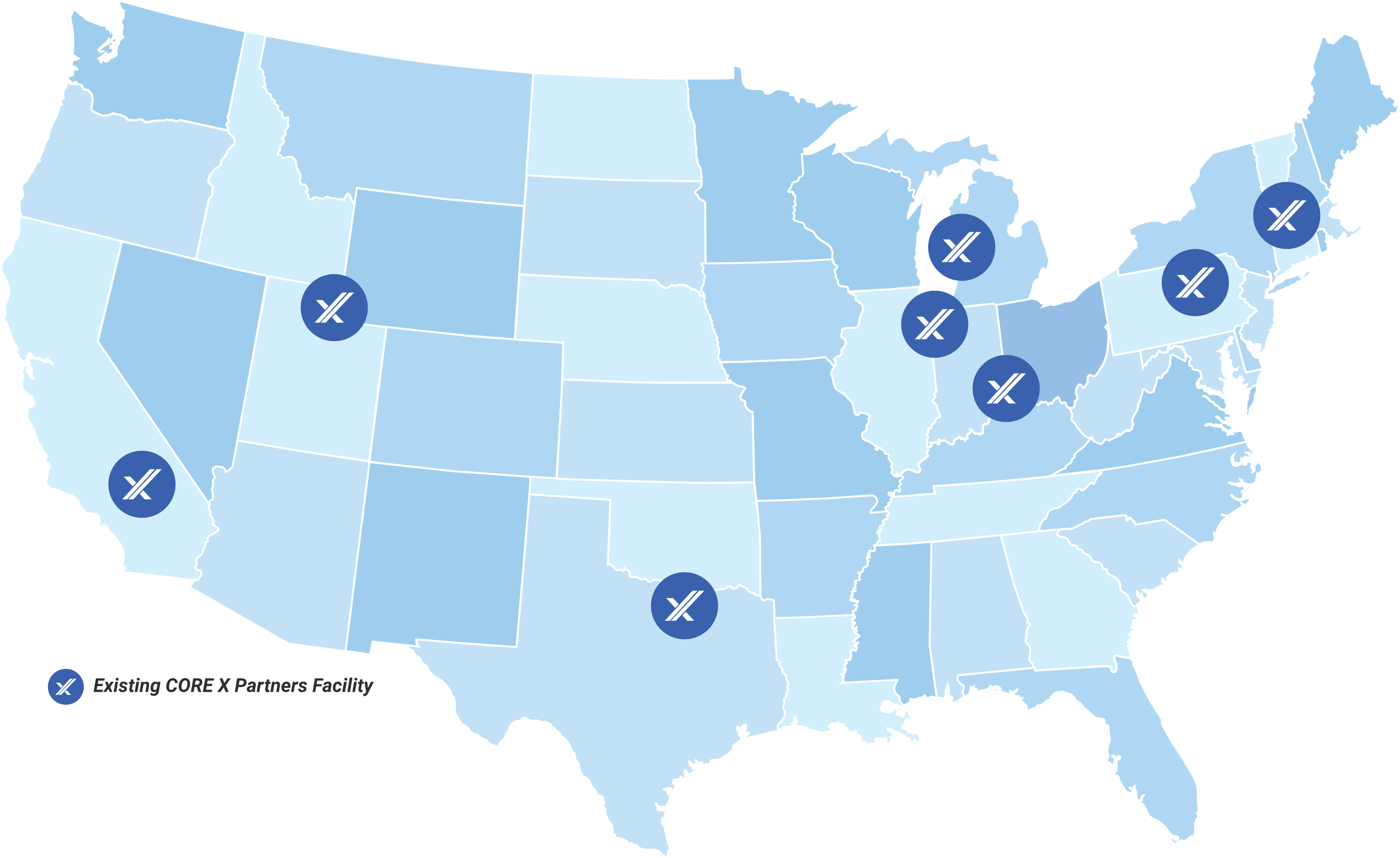
Cold chain compliance depends on consistent network execution combined with individual facility quality processes. CORE X Partners approaches compliance as a network-level discipline. Temperature-controlled warehousing, freight planning, and logistics oversight operate under shared operating standards designed to protect product integrity across regions.
This alignment includes:
- Standardized temperature setpoint governance across facilities
• Consistent staging and dock handling procedures
• Network-level documentation practices
• Integrated visibility across storage and freight movement
• Coordinated escalation protocols for exceptions
Each facility is operated by a Partnering Regional Operator (PRO) with deep local market knowledge, functioning within a unified compliance framework. This model preserves local accountability while maintaining consistent standards across regions.
Local Service. Nationwide Network.
Freight execution is also aligned with compliance expectations. Transportation planning is coordinated with staging and storage conditions, reducing exposure during transfers and ensuring that temperature-controlled products move between facilities under defined conditions. As distribution networks expand, this unified operating model replaces fragmented compliance with scalable oversight.
The result is cold chain compliance that supports growth rather than constraining it.
Scaling Without Compromising Safety, Quality, or Control
Cold chain compliance becomes more complex as frozen and refrigerated distribution expands across North America. Each added facility, freight lane, and retail destination increases both operational opportunity and compliance exposure.
Mid-sized food brands that scale successfully do so by prioritizing:
- Clear temperature standards
• Consistent SOP execution
• Network-wide traceability
• Structured contingency planning
• Integrated storage and freight alignment
Compliance discipline must grow alongside volume.
When the entire cold chain network, including storage, transportation, and logistics, operate under shared standards and coordinated oversight, brands protect product integrity while strengthening service reliability across regions.
CORE X Partners provides temperature-controlled storage and logistics solutions designed to protect compliance, preserve quality, and support risk-managed growth across a connected network. Our locally operated facilities function within unified operating standards that maintain temperature integrity and documentation consistency across regions. Contact CORE X Partners to strengthen your scalable cold chain compliance strategy.