
Cold chain supply chain management becomes significantly more complex as food brands expand into new regions. What begins as a manageable regional operation quickly requires coordinated inventory visibility, transportation tracking, compliance documentation, and performance monitoring across multiple facilities and lanes.
For mid-sized food brands building a scalable frozen and refrigerated distribution network across North America, physical cold storage capacity is only part of the equation. The systems that connect warehousing, freight, and data ultimately determine whether growth introduces control, or chaos.
Effective cold chain supply chain management depends on a technology stack that supports end-to-end visibility, measurable performance, and disciplined exception management across regions.
Talk To A Cold Chain Specialist
What Cold Chain Supply Chain Management Requires at Scale
Scaling cold-chain operations demands more than temperature-controlled storage. It requires coordinated systems that track product movement, monitor compliance, and identify risk before it results in claims or service failures.
At scale, cold chain supply chain management must support:
- Continuous temperature monitoring during storage and transit
- Unified visibility across multiple warehouse locations
- Real-time freight status updates and exception alerts
- Lot-level inventory tracking and traceability
- Performance reporting across regions and retail programs
Without these capabilities, brands rely on reactive communication and manual workarounds as distribution expands. The result is increased dwell time, unplanned expedited freight, audit risk, and service variability. Technology does not eliminate complexity, but it allows companies to manage it systematically.
End-to-End Visibility: The Foundation of a Scalable Cold Chain
The most critical layer of cold chain supply chain management is visibility, specifically, the ability to track product condition and movement across storage and transportation in real time.
Effective visibility systems include:
- Temperature Tracking – Continuous monitoring of refrigerated and frozen zones within facilities and during transport. Alerts must trigger before excursions become compliance issues.
- Geofencing and Transit Monitoring – Location-based tracking ensures that shipments follow defined routes and identifies delays early, especially during multi-region moves.
- Exception Workflows – Alerts should route directly to accountable stakeholders with defined escalation paths. If a shipment dwell time exceeds thresholds or a temperature deviation occurs, teams know who owns resolution.
Visibility without defined action paths adds noise. Visibility with disciplined response frameworks improves reliability.
WMS, TMS, and ERP Integration: What Mid-Sized Brands Should Prioritize
As distribution networks expand, system integration becomes more important than system volume. Cold chain supply management relies on how well warehouse management (WMS), transportation management (TMS), and enterprise resource planning (ERP) systems connect.
For growing food brands, priorities should include:
WMS Focus Areas
- Lot control and traceability
- FEFO (First Expired, First Out) logic
- Real-time inventory accuracy
- Temperature-zone segregation
TMS Priorities
- Coordinated outbound scheduling
- Carrier performance tracking
- Dwell-time monitoring
- Consolidation planning support
ERP Touchpoints
- Order integration with warehouse flows
- Forecast signals tied to transportation planning
- Financial linkage between freight cost and SKU performance
The goal is not building the most complex system environment. It is ensuring that critical handoffs, order to warehouse, warehouse to transportation, transportation to delivery, share synchronized data.
Disconnected systems create blind spots. Integrated data creates control.

KPIs That Actually Predict Cold Chain Problems
Many brands track high-level metrics such as monthly freight spend or total claims. While useful, these lagging indicators do not prevent failure. Scalable cold chain supply chain management depends on predictive KPIs that highlight risk early.
Key metrics to monitor include:
- Dwell Time at Dock and Staging Areas – Extended dwell increases both cost and temperature exposure.
- Temperature Excursions – Track frequency and root cause, not just occurrence.
- OTIF (On Time In Full) – Retail performance penalties escalate quickly during regional expansion.
- Claims Rate per Lane or Facility – Patterns often reveal routing inefficiency or handling breakdowns.
- Inventory Accuracy – Misalignment at the warehouse level cascades into transportation inefficiency.
- Fill Rate During Promotions – Seasonal or promotional spikes frequently expose forecasting gaps.
These metrics allow leaders to move from reactive problem-solving to structured operational control.
Forecasting and Replenishment Signals in Cold Chain Supply Chain Management
Forecasting failures are one of the fastest ways to destabilize cold chain supply chain management. Promotions, retailer expansions, seasonal demand spikes, and new-region launches create volume swings that can quickly overwhelm storage and transportation capacity if not anticipated correctly.
Cold chain forecasting must extend beyond sales projections and incorporate operational signals, including:
- Lane-level capacity trends for refrigerated and frozen freight
- Dwell-time patterns at specific facilities
- Retail compliance windows and appointment lead times
- Temperature-controlled equipment availability during peak seasons
- Historical spoilage or claims patterns tied to seasonal swings
Mid-sized brands often rely on aggregate demand forecasting without translating that data into network-level planning. A scalable cold chain requires tighter integration between sales forecasting and distribution execution.
Effective cold chain supply chain management connects:
Sales & promotions → Inventory positioning → Facility capacity planning → Transportation scheduling → Retail delivery performance
When forecasting feeds directly into staging plans and freight allocation, brands reduce expedited shipments, minimize temperature exposure from unplanned holds, and stabilize cost fluctuations during seasonal surges.

Governance: Who Owns Cold Chain Exceptions?
Technology and metrics provide visibility, but without defined governance, problems persist.
As distribution expands, accountability can become unclear. Who owns:
- A temperature excursion during transit?
- Excessive dwell time at a facility dock?
- A retailer rejection tied to early arrival or paperwork?
- An inventory misalignment that triggers last-minute re-routing?
Cold chain supply chain management requires clearly defined ownership across storage and transportation.
A scalable governance framework typically includes:
- Defined Escalation Paths – Temperature deviations and service exceptions trigger a structured response protocol with named accountability.
- Weekly Cross-Functional Oerating Reviews – Storage, logistics, and supply-chain teams review KPIs such as dwell time, OTIF, claims, and forecast accuracy.
- Root-Cause Analysis Discipline – Rather than addressing isolated incidents, teams identify systemic drivers, lane design, packaging configuration, appointment scheduling, or consolidation breakdowns.
- Shared Performance Dashboards – Network-wide transparency prevents siloed decision-making between facilities and freight teams.
Without governance discipline, technology becomes a reporting tool. With governance alignment, it becomes a control system.
How CORE X Aligns Technology, Storage, and Transportation at Scale
Cold chain supply chain management performs best when storage operations and freight execution operate within the same network framework.
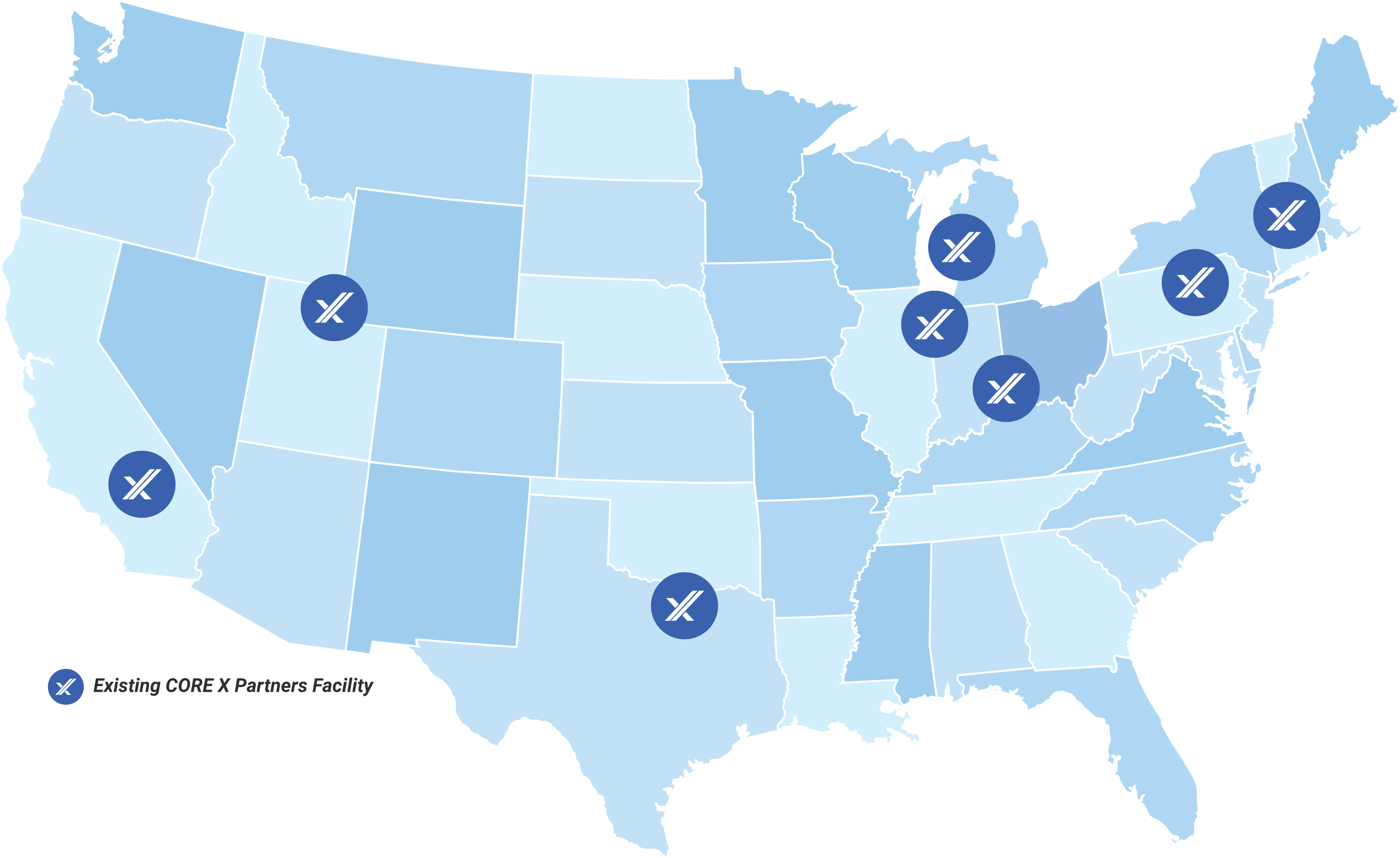
CORE X Partners aligns temperature-controlled storage, transportation, and data systems under a unified operating model designed to support scalable growth across regions.
The foundation includes:
- Integrated Facility Systems – Temperature monitoring, lot control, and inventory visibility operate within standardized frameworks across CORE X locations.
- Aligned Freight Execution – Refrigerated LTL, truckload, consolidation, and brokerage planning connect directly to storage workflows, staging capacity, and routing strategy.
- Network-Wide Visibility – Facilities operate under shared reporting standards, enabling multi-region visibility rather than isolated site-level reporting.
- Partnering Regional Operator (PRO) Oversight – Each facility is locally managed by an experienced Partnering Regional Operator while operating within network-wide expectations for temperature integrity, compliance, and execution consistency.
This alignment reduces handoff risk between storage and transportation, improves planning accuracy, and stabilizes performance across expanding distribution footprints.
Rather than layering technology on top of fragmented providers, CORE X operates cold chain supply chain management as an integrated system where freight, storage, data, and governance function together.
Building a Technology-Enabled Cold Chain Without Adding Complexity
Scaling cold chain distribution across North America does not require the largest technology stack. It requires alignment.
Mid-sized food brands that build scalable cold chain supply chain management focus on:
- Integrated visibility across storage and freight
- Predictive KPIs rather than reactive reporting
- Forecast-driven inventory and lane planning
- Defined governance and exception ownership
- Coordinated regional execution supported by network standards
When cold storage, transportation, and data systems function within a unified framework, brands gain control over cost, compliance, and service performance, even as volume, SKUs, and markets expand. Cold chain supply chain management becomes a structured operating system rather than a collection of regional processes.
CORE X Partners delivers integrated cold chain supply chain management that connects temperature-controlled storage, aligned freight execution, and unified reporting across a nationwide network. Our model combines local operational expertise with shared systems, governance, and performance oversight to support scalable frozen and refrigerated distribution. Contact CORE X Partners to strengthen your scalable cold chain supply chain management strategy.