Shipping to retail DCs requires more than getting product onto a truck. Food brands have to protect delivery timing, order completeness, product accuracy, documentation, and accepted product condition before the shipment ever reaches the receiving dock.
That is where OTIF and fill rate often get confused.
OTIF stands for On Time in Full. In retail distribution, OTIF generally measures whether an order arrives within the customer-defined delivery window and in the expected quantity. Fill rate measures whether the ordered product was available and fulfilled.
For frozen and refrigerated products, there is another layer. A shipment can arrive on time and in full but still create a service failure if the product is rejected for temperature, condition, labeling, documentation, pallet quality, or ASN/EDI mismatch. Food brands need to understand the difference between these metrics so they can fix the right problem before shipping to retail DCs.
What OTIF Measures Before Shipping to Retail DCs
OTIF measures delivery performance. At a basic level, the retailer wants to know whether the order arrived when it was supposed to arrive and whether it arrived complete.
The “on time” portion usually relates to a customer-defined delivery window, appointment time, or routing requirement. The “in full” portion relates to whether the shipped quantity matches the purchase order or expected order quantity.
The details matter because retailer requirements are not universal. Different customers, programs, and distribution networks may define scorecard performance differently. Some retailers may focus heavily on appointment compliance. Others may place more emphasis on order completeness, documentation accuracy, delivery window performance, or accepted receiving condition.
For cold chain shipments, OTIF should not be viewed as a transportation-only metric. A late truck may create an OTIF issue, but so can poor dock scheduling, incomplete order allocation, inventory stored in the wrong region, inaccurate shipment data, or product that is not ready when the carrier arrives.
What Fill Rate Measures
Fill rate measures whether the ordered product can be fulfilled from available inventory. It is primarily an inventory availability and order fulfillment metric, not a delivery timing metric.
For food brands, fill rate can be measured several ways. A line fill rate may show whether individual order lines were filled. A case fill rate may show whether the requested number of cases shipped. An order fill rate may show whether the full order shipped complete. A unit fill rate may measure fulfillment at the unit level.
In the cold chain, fill rate depends on more than having inventory somewhere in the network. Product has to be available in the right location, in the right condition, with the right lot or date code, and with enough remaining shelf life to meet customer requirements.
That connects fill rate to inventory accuracy, safety stock, production planning, FEFO discipline, SKU-level reporting, lot control, and short-date risk. If product exists but is sitting in the wrong region, tied up in hold status, short-dated, or not visible in the system, the brand may still ship short.
OTIF, Fill Rate, and Accepted Condition Are Related, But Not the Same
Food brands can lose scorecard performance when they treat these metrics as interchangeable. An OTIF problem may not be a fill rate problem. A fill rate problem may not be a transportation problem. A rejected load may turn an otherwise successful delivery into a costly service failure.
A simple way to separate the metrics is to look at what each one is really telling the business.
| Metric | What it shows | Cold chain risk |
| OTIF | Did the order arrive on time and complete? | Missed appointment, late arrival, short shipment, routing issue |
| Fill rate | Was the ordered product available and fulfilled? | Inventory inaccuracy, wrong region, short-date product, stockout |
| Order accuracy | Did the right product, quantity, lot, and documentation ship? | Wrong SKU, wrong date code, PO mismatch, ASN/EDI issue |
| Rejection rate | Was the product accepted at receiving? | Temperature issue, product condition, labeling, pallet quality, documentation problem |
The goal is not to manage these metrics in isolation. The goal is to understand how they influence each other before products move into the retail distribution network.
Where Cold Chain Providers Influence Each Metric
A cold chain provider can influence OTIF by helping align order readiness, staging, dock timing, transportation planning, appointment scheduling, and shipment visibility. When frozen or refrigerated products need to move into a retail DC, the outbound process has to be coordinated from warehouse release through delivery.
Fill rate is influenced by a different but connected set of controls. Inventory accuracy, lot tracking, FEFO rotation, SKU-level visibility, and regional inventory placement all affect whether the right product can be shipped in the right quantity.
Both metrics improve when storage, freight, logistics, data visibility, and customer communication are connected. A food brand may have strong inventory on paper, but still miss performance expectations if order data, freight timing, and customer requirements are not aligned.
This is especially important for frozen and refrigerated brands with multiple customers, retail programs, regional warehouses, and temperature requirements. A shipment does not succeed because one department did its job. It succeeds when inventory, warehousing, transportation, documentation, and customer communication work together.
Common Scorecard Problems Before Shipping to Retail DCs
Many retail scorecard issues begin before the shipment leaves the facility.
Inventory may exist, but it may be stored too far from the target retail DC to support the required delivery window. Product may be available, but the wrong lot or date code may be picked. An order may ship short because inventory visibility was outdated. A trailer may arrive on time, but the product may be rejected because of temperature concerns, pallet condition, or documentation issues.
ASN, EDI, PO, label, or receiving detail mismatches can create problems even when the physical shipment is accurate. In cold chain distribution, product can also face risk when it is staged too early, held too long at the dock, or moved through too many disconnected handoffs.
These issues create a practical lesson for food brands: do not wait until the truck is late to diagnose the scorecard problem. By then, the root cause may already be several steps behind the shipment.
What to Ask Your 3PL Before a Retail Launch
Before shipping to retail DCs at scale, food brands should understand whether their 3PL can support both inventory performance and retail delivery execution.
A strong provider should be able to explain how they manage retailer-specific routing requirements, appointment scheduling, inventory accuracy, lot traceability, FEFO discipline, temperature-controlled staging, shipment visibility, and exception communication.
Food brands should also ask whether the provider can support refrigerated LTL consolidation for lower-volume retail lanes. Not every retail order justifies a full truckload, but traditional LTL can add handling, dwell time, and visibility challenges. For frozen and refrigerated brands, consolidation can help support smaller, more frequent replenishment while keeping freight planning connected to cold chain requirements.
The most useful question is not only, “Can you ship it?” It is, “Can you show us what happened, why it happened, and how we improve the next shipment?”
Visibility Turns Metrics into Action
OTIF and fill rate reports are useful only if they help teams make better decisions. Monthly scorecards can show where performance changed, but connected visibility helps teams act before a problem becomes a deduction, rejection, or missed delivery window.
Food brands need visibility into inventory status, order progress, shipment movement, temperature records, appointment status, and exception history. WMS-based inventory tracking, shipment status updates, temperature data, EDI integration, KPI reporting, and customer portal visibility can help teams reduce avoidable surprises.
For example, real-time inventory visibility can help prevent avoidable shorts before an order is released. Shipment tracking can identify at-risk loads before the appointment window is missed. Temperature records and exception notes can help clarify whether a receiving issue was tied to storage, staging, transportation, or customer-side delays.
Better visibility does not eliminate every scorecard issue. It gives teams a stronger chance to respond earlier and classify the root cause more accurately.
Executive Takeaway: Align Inventory, Freight, Compliance, and Data
OTIF protects the delivery promise. Fill rate protects product availability. Accepted product condition protects the value of the shipment.
For food brands shipping frozen and refrigerated products to retail DCs, all three matter. A complete order still has to arrive on time. An on-time shipment still has to be accepted. Available inventory still has to be visible, accurate, properly rotated, and positioned close enough to meet retailer requirements.
The best way to improve these metrics is to align the systems and teams that affect them. Cold storage, inventory control, order fulfillment, transportation planning, retailer compliance, EDI workflows, temperature visibility, and customer communication all play a role.
Stronger Retail DC Performance Starts Before the Shipment Leaves
Food brands can improve retail delivery performance by understanding which metric they are trying to fix. OTIF, fill rate, order accuracy, and rejection rate each point to different operational issues, and each requires a different response.
When cold chain providers connect storage, freight, logistics, visibility, and compliance controls, food brands have a stronger foundation for shipping to retail DCs with fewer avoidable gaps. That connected model helps protect product quality, reduce service issues, and support more consistent execution across regional and national retail distribution networks.
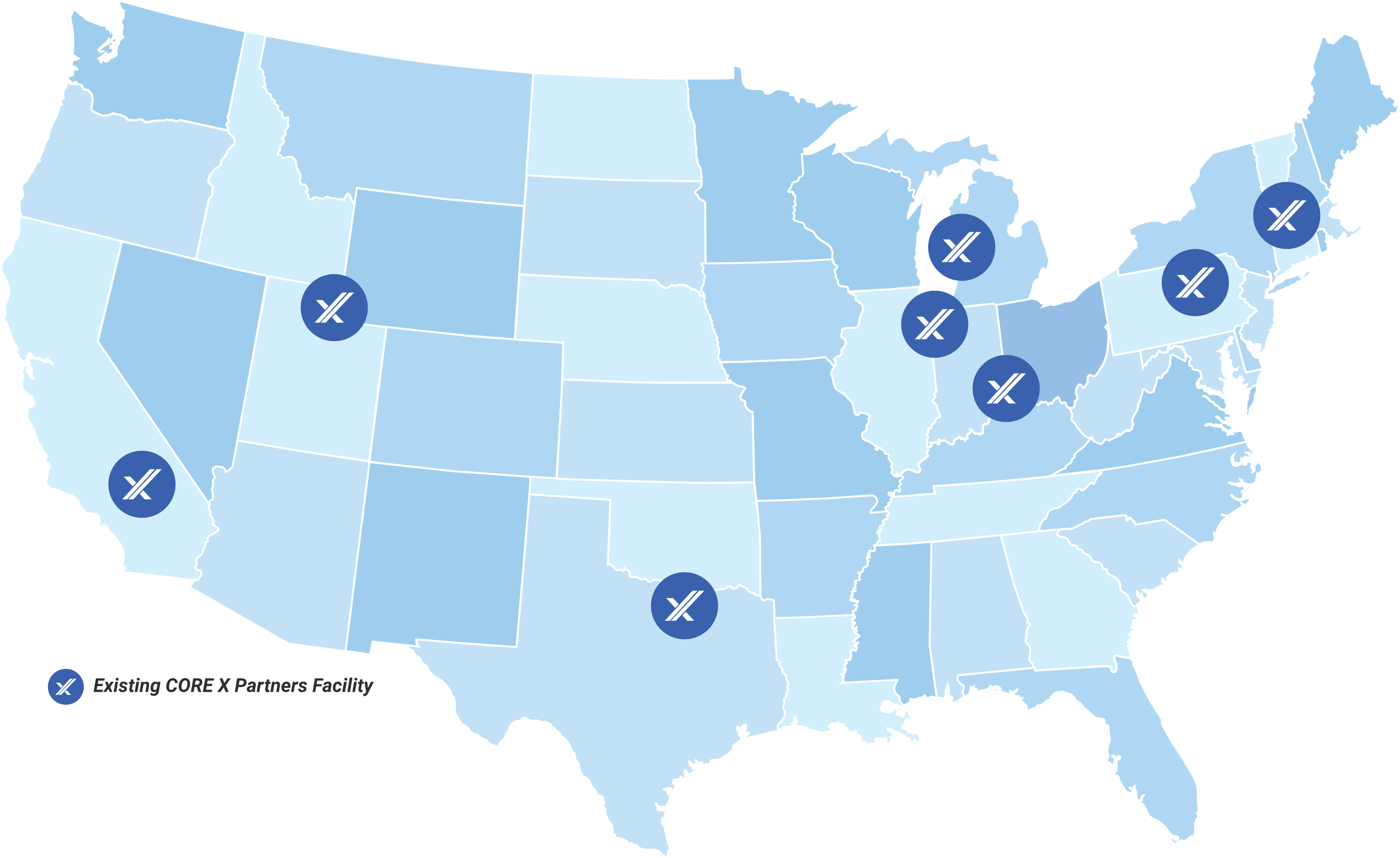
CORE X Partners helps food manufacturers, distributors, retailers, and foodservice companies protect product quality, preserve cold chain performance, and provide more reliable retail distribution through a nationwide cold chain network. With experienced regional operators, connected technology, and coordinated storage and transportation support, CORE X helps customers reduce handoffs, improve visibility, and strengthen performance before shipping to retail DCs. Contact CORE X Partners to learn how our integrated cold chain solutions can support stronger OTIF, fill rate, and retail delivery performance for frozen, refrigerated, and temperature-sensitive products.