Choosing a refrigerated 3PL requires more than confirming that the provider uses warehouse and transportation software. Food companies need to know whether the provider can connect WMS, TMS, and cold chain execution across inventory, staging, dock planning, carrier coordination, freight tracking, reporting, compliance documentation, and exception management.
A strong refrigerated 3PL does not treat warehouse operations, freight, and customer reporting as separate functions. The right partner connects systems, people, facilities, workflows, and accountability in one operating model that supports product integrity, service performance, and growth.
Why “Has a WMS” and “Has a TMS” Is Not Enough
A refrigerated 3PL may have a Warehouse Management System and a Transportation Management System, but technology alone does not guarantee integrated execution. The real question is whether warehouse activity, transportation planning, and customer reporting work together in daily operations.
Disconnected systems can still create problems when:
- warehouse teams and transportation teams use separate workflows
- inventory status does not connect to carrier planning
- staging activity does not align with trailer readiness
- freight tracking does not connect to customer reporting
- exceptions are handled through emails, phone calls, or spreadsheets
- leadership cannot see performance across facilities, lanes, and customers
A WMS should help track inventory status, lot details, temperature records, and product movement. A TMS should help manage order entry, carrier dispatch, route planning, and shipment tracking. CORE X supports these functions through a unified WMS, EDI integration, customer portal access, business intelligence tools, and freight services that include TMS-supported carrier dispatch, route planning, and real-time tracking.
For food companies, the evaluation should focus on execution. Can the provider show how inventory becomes an order, how the order becomes a shipment, how the shipment is tracked, and how exceptions are resolved?
Capabilities
1. Integrated Warehouse and Freight Operations
A refrigerated 3PL should connect warehouse execution with transportation execution. That connection matters most at the handoff between inventory allocation, picking, staging, dock planning, carrier assignment, dispatch, and delivery confirmation.
A qualified cold chain 3PL partner should support:
- shared planning between inventory, staging, dock, and dispatch teams
- temperature-controlled storage connected to outbound freight planning
- LTL, truckload, brokerage, consolidation, and regional transportation
- coordination between order readiness and carrier availability
- dock planning that reduces dwell time and congestion
- customer communication when pickup or delivery exceptions occur
These capabilities help close the gaps that lead to missed pickups, overstaged product, detention, and service failures.
CORE X supports this through a coordinated cold chain model that connects warehousing, freight, and value-added services. Its capabilities include private temperature-controlled fleets, full-service brokerage, truckload and LTL consolidation programs, intermodal and drayage services, expedited moves, EDI-enabled coordination, real-time temperature monitoring, electronic freight tracking, and 24/7 customer support.
2. Temperature-Controlled Infrastructure
A refrigerated 3PL must have the physical infrastructure to support the products being stored and moved. Systems matter, but cold chain execution still depends on facilities, equipment, dock procedures, staging discipline, and product handling standards.
Evaluate whether the provider can support:
- frozen, refrigerated, and deep-frozen environments
- product-specific storage requirements
- appropriate dock and staging practices
- temperature-zone discipline
- procedures that reduce unnecessary product exposure
- cold chain movement across multiple facilities or regions
A refrigerated warehouse and freight provider should be able to explain how products move from storage to staging to loading without creating avoidable dwell time or handling risk. The facility network should also match the transportation model. A provider with strong software but limited facility coverage, weak staging processes, or disconnected freight support may still struggle with reliable cold chain execution.
3. Data Visibility and Reporting
A refrigerated 3PL should provide visibility that helps operations teams, customer service teams, and executives manage the cold chain. Reporting should connect warehouse and transportation activity so customers can see what is happening across inventory, orders, shipments, exceptions, and performance.
Evaluate whether the provider can report on:
- inventory status
- lot details
- temperature records
- product movement
- shipment status
- carrier assignment
- exception alerts
- customer reporting
- KPI scorecards
- performance by facility, lane, customer, or product group
CORE X uses a unified WMS to support visibility into inventory status, lot details, temperature records, and product movement. EDI integration supports data continuity between CORE X systems and customer platforms, while customer portal access and business intelligence tools help customers monitor activity across the network.
Visibility should also be practical. A dashboard only helps if it gives teams useful answers: what product is available, what has been picked, what is staged, what carrier is assigned, what shipment is delayed, and who owns the next action.
4. Compliance and Documentation Support
A refrigerated 3PL should help customers maintain consistent documentation across warehouse and transportation activity. This matters when a customer needs to review shipment history, respond to a claim, investigate a temperature concern, or support an audit.
Evaluate whether the provider supports:
- documentation consistency
- chain-of-custody records
- lot and expiration tracking
- hold and release status
- temperature exception handling
- corrective action documentation
- customer and audit support
- reporting across storage and transportation workflows
BRCGS Storage and Distribution reflects best practices for risk-based product safety management systems and continuous improvement across storage and distribution operations. It is a useful benchmark when evaluating refrigerated 3PL compliance support, product safety systems, documentation discipline, and audit readiness.
A 3PL’s compliance capabilities should connect directly to daily execution. If a shipment is delayed, a product is held, or a delivery exception occurs, the provider should be able to show what happened, when it happened, who acted, and how the issue was resolved.
5. Network Design and Scalability
A refrigerated 3PL should support growth without forcing customers to rebuild processes every time they add a region, customer, SKU, or lane. Network design matters because cold chain distribution often expands in stages.
Evaluate network scalability by looking at:
- facilities near production, ports, customers, or retail distribution centers
- access to regional and national transportation lanes
- consistent standards across locations
- local execution with shared systems
- multi-region fulfillment capabilities
- capacity to add regions without creating fragmented workflows
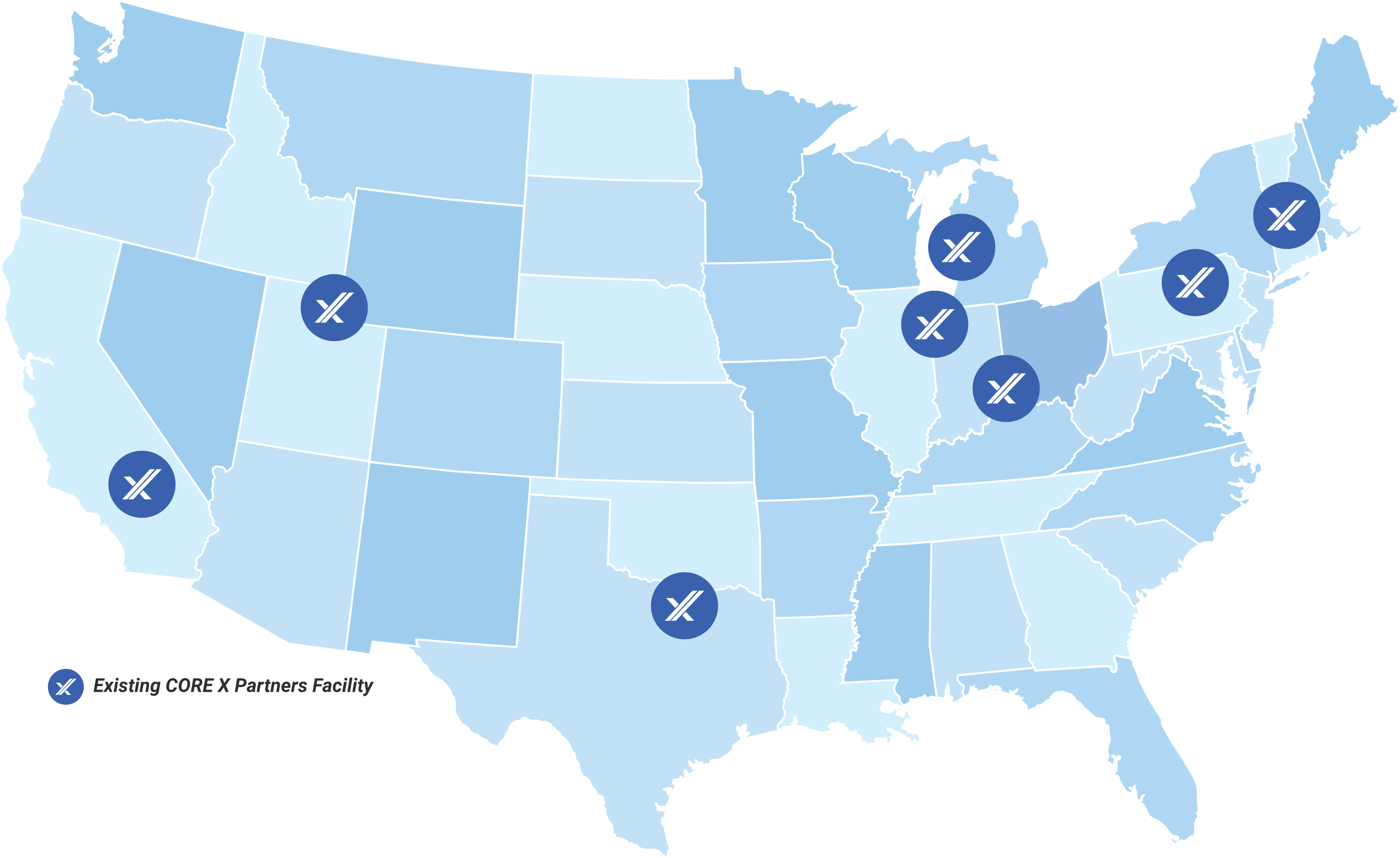
CORE X operates as a national cold chain logistics network with experienced cold storage operators, transportation, consolidation, and logistics solutions, along with EDI and 24/7 online customer portal access.
For food companies, the best refrigerated 3PL model combines regional execution with shared standards. Local teams understand market conditions, customer expectations, facility operations, and freight realities. Shared systems and network-level coordination keep those regional operations from becoming disconnected silos.
6. Clear Implementation Process
A refrigerated 3PL should be able to explain how integration will work before go-live. This includes data, SOPs, customer requirements, testing, reporting, and escalation procedures.
Evaluate implementation readiness through:
- data mapping
- SOP alignment
- customer requirements review
- order and inventory rules
- EDI/API needs
- WMS/TMS workflow testing
- reporting setup
- phased rollout
- exception escalation planning
- go-live support
Implementation quality determines whether a provider’s capabilities turn into consistent execution. A strong provider should explain how orders flow from WMS to TMS, how exceptions are escalated, how teams communicate during transition, and how performance will be measured after go-live.
Refrigerated 3PL Vendor Evaluation Scorecard
A structured scorecard can help executives compare providers beyond basic capability claims.
| Evaluation Area | What to Look For | Why It Matters |
| Warehouse execution | Inventory status, lot control, staging discipline | Confirms product readiness and handling accuracy |
| Transportation execution | Carrier planning, dispatch, freight tracking | Connects order readiness to movement |
| Cold chain control | Temperature zones, staging practices, exception handling | Protects product integrity |
| Visibility | WMS, TMS, EDI, portal, reporting | Gives teams one operating view |
| Compliance support | Documentation, traceability, audit readiness | Supports customer and regulatory review |
| Scalability | Multi-region facilities and shared standards | Supports growth without fragmentation |
| Implementation | Data mapping, SOPs, testing, rollout support | Reduces transition risk |
This scorecard helps buyers ask better questions. A provider may have strong warehouse operations but weak freight coordination. Another may offer transportation capacity without strong inventory visibility. The best refrigerated 3PL partner should connect the full operating model.
Sample RFP Questions for a Refrigerated 3PL
Food companies should ask specific questions about how a provider connects WMS, TMS, and cold chain execution. These questions can help separate true integration from surface-level technology claims.
Important questions include:
- Can you show how an order flows from WMS to TMS?
- How do inventory status, pick status, staging, dock planning, and freight dispatch connect?
- How are exceptions handled across storage and transportation?
- What reporting will our leadership team receive?
- Which systems integrate with customer platforms?
- Do you support EDI, API, portal access, or recurring reporting?
- How do you coordinate multi-region distribution?
- How do you document temperature exceptions, carrier delays, and delivery issues?
- How do you manage customer-specific requirements?
- What does implementation look like from data mapping through go-live?
These questions also reveal ownership. When storage and transportation overlap, the provider should clearly define who manages the issue, who communicates with the customer, and how corrective action is documented.
Example Scenario: Scaling From Regional to National Refrigerated Distribution
A frozen food brand may begin with one regional warehouse and a few carrier relationships. That structure often works in the beginning because order volume, customer requirements, and freight lanes remain manageable.
As the brand expands, complexity increases. New retail distribution centers, foodservice customers, SKUs, regions, and delivery windows create more pressure on warehouse operations and transportation planning. The company may need better reporting, stronger appointment compliance, more flexible freight options, and more consistent handling procedures.
A capable refrigerated 3PL should help the brand scale by connecting:
- inventory visibility across facilities
- warehouse SOPs across regions
- freight planning across lanes
- LTL, truckload, brokerage, and consolidation options
- customer reporting
- exception management
- compliance documentation
This is where integrated WMS, TMS, and cold chain execution becomes a growth advantage. The company can add markets without rebuilding the operating model each time.
How CORE X Connects WMS, TMS, and Cold Chain Execution
CORE X Partners connects refrigerated storage, freight, visibility, and logistics coordination through a national cold chain network. The CORE X model combines regional cold storage expertise with shared technology, transportation support, EDI capabilities, customer portal access, and business intelligence tools.
CORE X freight services support integrated transportation that coordinates with warehouse operations, multi-vendor LTL consolidation, freight brokerage, private fleet reefer trailers, EDI, electronic freight tracking, data analytics, and TMS-supported shipment execution.
For food manufacturers and distributors, this structure supports a more connected cold chain operation. Warehouse teams can manage inventory and staging. Transportation teams can coordinate carriers, dispatch, consolidation, and delivery. Customer-facing teams can access reporting that connects product movement, shipment status, and exception visibility.
Choose a 3PL That Can Execute, Not Just Integrate Systems
A refrigerated 3PL should be evaluated on how well it connects WMS, TMS, and cold chain execution in daily operations. The strongest provider will show how systems, facilities, freight, reporting, compliance, and people work together to reduce risk and support growth.
Technology matters, but execution matters more. Food companies need a 3PL that can manage refrigerated inventory, coordinate freight movement, document exceptions, report performance, and scale across regions without creating new operational silos.
CORE X Partners helps food manufacturers and distributors connect WMS, TMS, and cold chain execution through integrated storage, freight, visibility, and reporting solutions. The CORE X national network supports regional execution with shared standards, logistics coordination, and scalable cold chain capabilities. Contact CORE X Partners to request a cold chain logistics consultation for WMS, TMS, and cold chain execution.