Temperature compliance is often discussed as a food safety requirement, but for frozen and refrigerated brands shipping into retail distribution networks, it is also a retail performance issue.
A shipment can arrive within the delivery window and still fail at receiving. If the product is out of temperature range, has questionable temperature history, shows signs of poor handling, or lacks the right documentation, the retailer may reject the load or issue a claim. That turns a cold chain problem into a scorecard problem.
For food brands, temperature compliance affects more than product condition. It can influence retailer acceptance, OTIF performance, chargebacks, replenishment, shelf availability, customer relationships, and future growth opportunities.
What Temperature Compliance Means in Retail Cold Chain Distribution
Temperature compliance means maintaining required product conditions across the full cold chain. That includes storage, staging, loading, transportation, delivery, and receiving handoffs.
It is not just a single reading at one point in time. A compliant cold chain depends on the right temperature zones, trained teams, equipment readiness, documented procedures, monitoring, and timely response when conditions change.
For frozen and refrigerated compliant cold chain depends on the right temperature zones, trained products, the risk often appears during transitions. Product may be held correctly in storage, then face exposure during staging. A trailer may be scheduled, but not ready. A dock may become congested. A delivery appointment may shift after the product has already moved into the outbound process.
Temperature compliance is strongest when each handoff is managed as part of one connected process.
Why Temperature Compliance Affects Retail Scorecards
Retailers do not only measure whether a shipment shows up. They measure whether usable, saleable product arrives as expected.
That distinction matters. A load may be on time and complete, but if the product is rejected, the retailer still does not have inventory to place into its network. The result may include a chargeback, claim, missed replenishment, emergency replacement shipment, or strained buyer relationship.
Temperature compliance can affect retail performance in several ways. A rejected load may reduce available inventory. A delayed inspection or dispute may interrupt replenishment timing. A product with reduced shelf life may create additional pressure for the retailer. Repeated temperature-related issues may also reduce confidence in the supplier’s cold chain.
For brands that rely on retail distribution centers, temperature compliance protects both the product and the delivery promise.
Where Cold Chain Temperature Failures Happen
Temperature failures do not only happen in transit. They can occur anywhere product moves from one controlled environment or process step to another.
Common risk points include receiving delays, poor pre-cooling, improper staging, dock dwell time, loading delays, excess handling during LTL transfers, mixed-temperature mistakes, and customer-side receiving delays.
These issues are not always dramatic. Often, they are small timing or handling problems that compound. Product may sit longer than expected in staging. A late pickup may increase dwell time. A trailer may not be ready when the order is ready. A missed delivery appointment may extend transit or shorten the retailer’s usable shelf life.
That is why temperature compliance has to be managed before, during, and after transportation. The cold chain is only as strong as the handoffs between storage, loading, freight movement, and receiving.
How Temperature Compliance Affects OTIF and Fill Rate
OTIF stands for On Time In Full. Fill rate measures whether ordered product is available and fulfilled. Both metrics can be affected when temperature compliance breaks down.
If a shipment arrives on time and in full but is rejected, the retailer still experiences a service failure. If rejected product has to be replaced, replenishment may be delayed. If a partial replacement is available, the order may become a fill-rate issue. If emergency freight is needed, costs increase while teams work to recover the customer commitment.
Temperature compliance also affects inventory planning. A load that is rejected, held, written off, or reworked can reduce available inventory and create pressure on future orders. That can affect SKU availability, customer allocation, and the ability to meet upcoming retail demand.
In that sense, thermal compliance is not separate from OTIF and fill rate. It directly influences whether the product can be accepted, replenished, and sold.
Operating Controls That Reduce Temperature Compliance Risk
Temperature control depends on disciplined execution, not assumptions. Food brands need cold chain partners that can maintain the right environment and document how product moves through the process.
Important controls include temperature-controlled storage zones, SOPs for receiving and loading, dock discipline, product rotation, temperature monitoring, lot and date-code control, chain-of-custody documentation, preventive maintenance, and corrective-action records.
The purpose of these controls is practical. They help teams reduce exposure, identify issues earlier, and respond before a small exception becomes a rejected load.
For example, staging should be coordinated around pickup timing, not simply handled as soon as an order appears on the schedule. Trailer readiness should be confirmed before loading. Temperature records and exception notes should be available when questions arise. Corrective actions should be documented so repeat issues can be addressed by facility, lane, product, customer, or process.
These controls help protect product quality, but they also help protect retail execution.
Why Certifications and Documented Standards Matter
Documented standards and third-party certifications can support supplier approval, audit readiness, and customer confidence. They show that a cold chain provider has defined procedures for product handling, facility control, sanitation, documentation, corrective action, and operational discipline.
For food brands, certifications should not be viewed as marketing language alone. They can be part of a broader risk-management conversation with buyers, QA teams, and retail supply chain partners.
BRCGS-certified cold chain partners, where applicable, can help support confidence in storage and distribution practices. The larger point is that food brands need providers with documented processes, trained teams, and consistent standards across the operation.
Certifications do not remove all risk. They help show that the provider is operating within a structured system designed to manage risk more consistently.
What Leaders Should Review Monthly
Temperature compliance should be reviewed as a retail performance metric, not only as a QA or food safety issue. Leadership teams need to understand where temperature risk is showing up, what it costs, and whether corrective actions are reducing repeat issues.
A monthly review should connect operational events to business impact.
| Area to review | Why it matters |
| Temperature exceptions | Shows where product condition risk appeared |
| Rejected loads | Identifies affected customers, lanes, facilities, or products |
| Claims and chargebacks | Connects compliance failures to financial impact |
| Product loss or write-offs | Shows where inventory value was lost |
| Corrective actions | Confirms whether issues are being resolved |
| Repeat root causes | Helps identify recurring facility, carrier, lane, or process problems |
| Replacement freight | Shows the cost of recovery after a failed delivery |
This type of review helps teams move beyond “the load was rejected” and toward a better question: why did the failure happen, and how do we prevent it next time?
How to Turn Thermal Compliance into a Service Advantage
Strong temperature compliance can become more than a defensive measure. It can support stronger retailer relationships.
Food brands that can show clear documentation, reliable cold storage controls, temperature-aware transportation planning, and consistent exception response are better prepared for retailer reviews. They can answer questions faster, support claims investigations, and build more confidence before expanding into new regions or customer programs.
This is especially important for brands managing frozen and refrigerated growth across multiple retail distribution centers. As the network expands, the margin for error gets smaller. More facilities, lanes, customers, and delivery windows create more handoffs where temperature risk can appear.
A cold chain partner with regional execution, national network support, shared technology, and connected visibility can help food brands manage that complexity with greater consistency.
Improve Retail Scorecard Performance Through Stronger Temperature Control
Temperature control protects product quality, but it also protects retail performance. For frozen and refrigerated food brands, accepted delivery depends on disciplined storage, staging, loading, transportation, documentation, and exception response.
When those controls work together, brands are better positioned to reduce rejected loads, avoid chargebacks, protect shelf availability, and strengthen retail scorecard performance. Temperature compliance becomes part of a larger operating strategy: protecting the product, preserving its value, and supporting more reliable distribution.
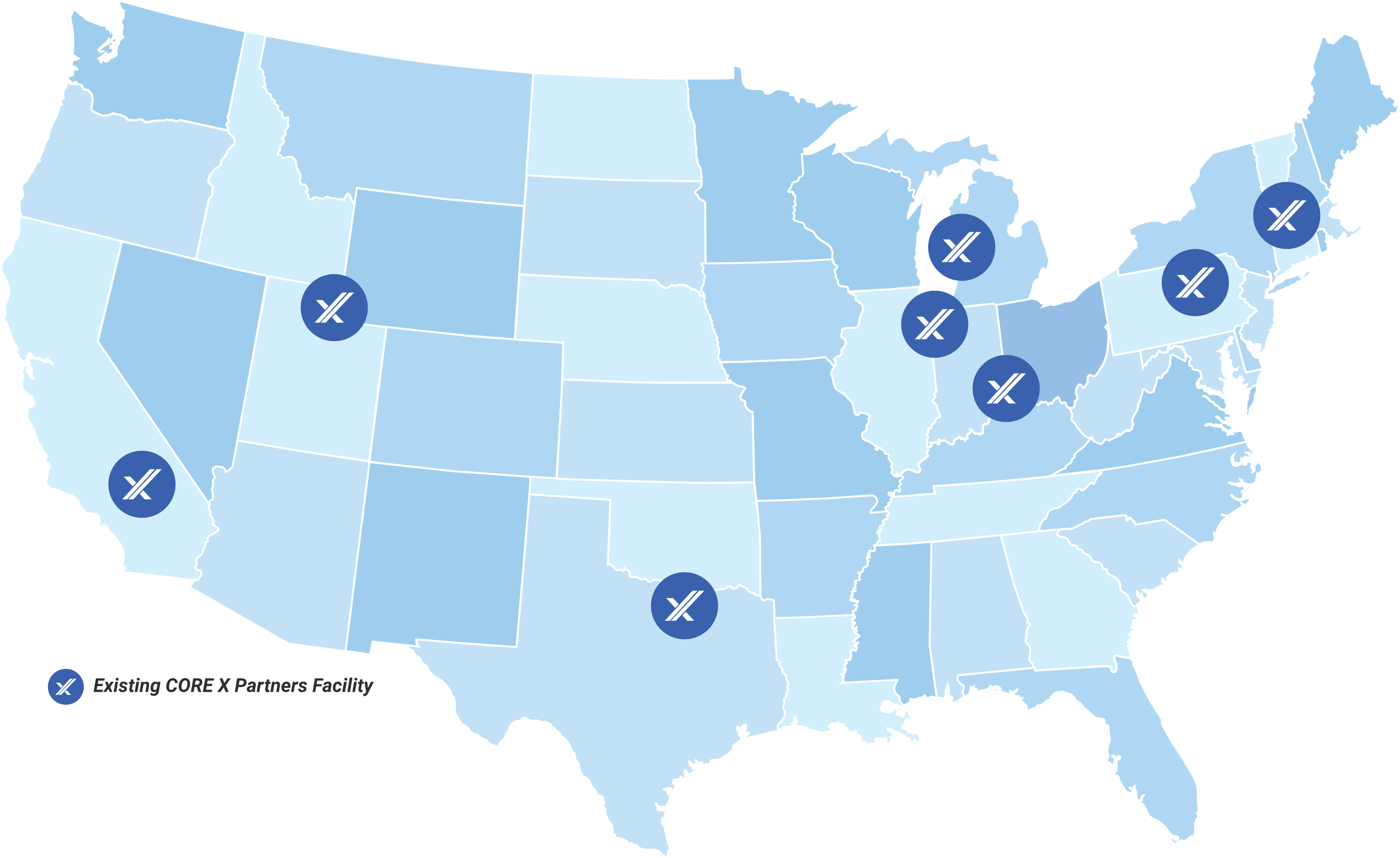
CORE X Partners helps food companies protect temperature-sensitive products through a nationwide cold chain network built for storage, transportation, logistics, and distribution. With experienced regional operators, shared technology, documented processes, and connected visibility, CORE X helps customers reduce temperature risk across cold chain handoffs. Contact CORE X Partners to learn how our integrated cold chain solutions can support stronger temperature compliance, fewer rejected loads, and more reliable retail distribution performance.
Core X Partners August’26 Blog #6
Page Name: The Executive Playbook for Improving Retailer OTIF and Fill Rate with a Cold Chain 3PL
Existing URL:
New URL:
Title Tag: Improve OTIF and Fill Rate With a Cold Chain 3PL
Meta Description: Learn how a cold chain 3PL helps food brands improve retailer OTIF and fill rate through inventory placement, freight planning, visibility, and execution.
Keywords: cold chain 3PL
Blog Stem:
Image Name:
Alt Image Tag:
Word Count: 1717
Directives:
Resources:
Retailer OTIF and fill rate are not just warehouse or transportation metrics. They affect revenue, deductions, buyer confidence, shelf availability, customer service workload, and brand reputation.
OTIF stands for On Time in Full. In retail distribution, it generally measures whether an order arrives within the retailer’s required delivery window and in the expected quantity. Fill rate measures whether ordered product is available and fulfilled.
For frozen and refrigerated food brands, these metrics are even more complex. A shipment may leave the warehouse as complete but miss its appointment. It may arrive on time, but be rejected for temperature, documentation, pallet condition, or product accuracy. It may be available in the network but stored too far from the retail DC to support the required delivery window.
How to Align Retail Performance Goals with Your Cold Chain 3PL
A cold chain 3PL helps manage those connected issues across temperature-controlled storage, transportation, logistics coordination, visibility, and distribution. For executives, the goal is not to chase one metric in isolation. The goal is to build a cold chain operating model that improves retail performance without increasing product risk.
Step 1 — Quantify the Cost of Retail Performance Misses
Retail scorecard misses can look like operational problems, but they usually create financial consequences quickly. Chargebacks, deductions, rejected product, emergency freight, lost sales, out-of-stocks, customer service labor, and buyer frustration all carry a cost.
Executives need to understand where those costs are coming from before deciding what to fix. A late delivery may be expensive, but a rejected load can be even more damaging. A short shipment may hurt fill rate, but the root cause may be inventory placement, production timing, product allocation, or poor visibility.
The first step is to connect each miss to its financial impact. How much did the deduction cost? Was replacement freight required? Did the retailer lose shelf availability? Did customer service spend hours chasing updates? Did the issue repeat by customer, lane, product, or facility?
Once the cost is visible, leadership can prioritize the areas that will make the greatest difference.
Step 2 — Separate the Miss Types Before Choosing a Fix
Not every retail performance issue has the same cause. Treating every miss like a transportation failure can lead to the wrong solution.
A late but complete shipment may point to appointment scheduling, routing, dock timing, or carrier execution. An on time but short shipment may point to inventory accuracy, allocation, replenishment, or order fulfillment. A complete but rejected shipment may point to temperature compliance, pallet condition, documentation, or retailer receiving requirements.
Documentation failures create another category. The correct product may ship, but ASN, EDI, PO, label, or pallet data may not match the retailer’s expectations. In other cases, inventory may exist in the network but be stored in the wrong location to meet the required delivery window.
A cold chain 3PL should help identify these distinctions. The goal is to understand whether the miss started with inventory, warehouse execution, freight planning, compliance, temperature control, customer requirements, or communication.
Step 3 — Use a Cold Chain 3PL to Improve Inventory Placement
Inventory placement has a direct effect on OTIF, fill rate, transportation cost, and temperature risk. If product is stored too far from the retail DC, the delivery window becomes harder to meet. If inventory is concentrated in one location while demand expands into new regions, the brand may face more expedited freight, longer transit times, and tighter replenishment schedules.
A cold chain 3PL can help food brands evaluate where inventory should sit based on retail DC demand, order cadence, temperature requirements, customer growth, and regional shipping patterns. The question is not only, “Do we have product?” The better question is, “Do we have the right product in the right place, with enough time to deliver it correctly?”
Better inventory placement can reduce unnecessary transit pressure and give teams more flexibility when orders change. It can also support fill rate by making available inventory more usable for the customers and regions that need it most.
For frozen and refrigerated products, regional cold storage capacity becomes part of retail execution. It supports faster replenishment, shorter lanes, better appointment planning, and fewer last-minute decisions.
Step 4 — Align Cold Storage and Freight Planning
Cold storage and freight planning cannot operate on separate tracks if the goal is stronger retail performance. Warehouse teams influence order readiness, picking, staging, dock timing, product condition, and inventory accuracy. Transportation teams influence pickup timing, retail appointments, routing, trailer availability, consolidation, and delivery execution.
When those teams are not aligned, small gaps can become costly. Product may be staged before transportation is ready. A carrier may arrive before the order is complete. A retail appointment may be scheduled without enough visibility into dock capacity. Customer service may not have the information needed to communicate when something changes.
A cold chain 3PL helps by connecting warehouse activity with outbound movement. That alignment supports better dock scheduling, cleaner staging, improved trailer utilization, and more predictable dispatch.
Retail LTL consolidation can also play an important role for food brands that have frequent smaller shipments into retail DCs. When consolidation is connected to cold storage and freight planning, brands can move smaller replenishment orders more consistently without waiting for full truckload volume or relying on one-off LTL decisions.
Step 5 — Build a Shared Retail Performance Scorecard with Your 3PL
A scorecard should do more than report whether performance went up or down. It should help the brand and the cold chain 3PL understand what happened, why it happened, and what needs to change.
A useful executive scorecard should include metrics that connect service, inventory, compliance, temperature control, and cost.
| Metric | Why it matters |
| OTIF by customer and lane | Shows delivery performance patterns |
| Fill rate by SKU and customer | Identifies fulfillment and inventory issues |
| Temperature exceptions | Shows where product integrity risk appears |
| ASN/EDI accuracy | Helps reduce documentation-related chargebacks |
| Claims and rejections | Connects service failures to financial impact |
| Appointment compliance | Shows whether retail receiving windows are being met |
| Cost-to-serve by lane | Helps evaluate freight and network efficiency |
The value is in the root cause, not just the score. If OTIF is low, leadership needs to know whether the issue came from late staging, appointment availability, carrier performance, retailer requirements, weather, documentation, or inventory placement.
A shared scorecard also creates accountability. The customer and provider can review the same data, agree on the cause, and assign corrective actions.
Step 6 — Run Monthly Root-Cause Reviews
Retail performance improves when teams review misses as part of a regular operating rhythm. Monthly reviews should look beyond the final number and focus on the causes behind late deliveries, short shipments, rejections, temperature exceptions, and chargebacks.
The right review should include operations, logistics, customer service, finance, sales, and the cold chain 3PL. Each team sees a different part of the problem. Finance sees deductions and cost impact. Customer service sees retailer communication. Operations sees inventory and staging. Logistics sees lane performance and appointment risk.
This review should answer practical questions:
- Which customers, lanes, SKUs, or facilities created the most issues?
- Were misses caused by inventory, systems, carriers, retailer rules, or internal timing?
- Were corrective actions completed?
- Did the same issue repeat?
- Should inventory placement, replenishment logic, or freight planning change?
The goal is to move from explaining what went wrong to reducing the chance that it happens again.
Step 7 — Choose a Cold Chain 3PL Built for Retail Growth
A food brand may be able to manage retail distribution with a basic warehouse and carrier model early on. As the business grows, that model often becomes harder to control. More customers, regions, SKUs, delivery windows, and compliance requirements create more handoffs.
A cold chain 3PL built for retail growth should bring more than space and trucks. The right partner should connect temperature-controlled storage, transportation support, retail consolidation, WMS-based visibility, EDI capabilities, reporting, customer communication, and regional execution.
For executives, the provider evaluation should focus on execution. Can the 3PL support frozen and refrigerated inventory across the right markets? Can they coordinate storage and freight planning? Can they support retail-specific requirements? Can they show performance by customer, lane, SKU, or facility? Can they help the business scale without rebuilding the cold chain one region at a time?
The stronger the retail growth plan, the more important those capabilities become.
90-Day Cold Chain 3PL Improvement Roadmap
Executives do not need every operational detail on day one. They need a practical plan that helps the organization diagnose problems, align teams, and measure progress.
| Timeline | Focus | Goal |
| Days 1–30 | Diagnose misses and cost impact | Identify root causes by customer, lane, SKU, and facility |
| Days 31–60 | Align inventory, storage, and freight planning | Reduce preventable timing, fulfillment, and staging issues |
| Days 61–90 | Implement reporting and review cadence | Track progress, assign corrective actions, and improve accountability |
This type of roadmap turns OTIF and fill rate improvement into a managed initiative instead of a vague performance goal. It also gives leadership a way to evaluate whether the current cold chain model is supporting growth or creating avoidable friction.
Improve Retailer OTIF and Fill Rate Through Connected Cold Chain Execution
Improving retailer OTIF and fill rate requires more than pushing carriers harder or adding warehouse capacity. Food brands need to understand which misses are costing the business, separate the root causes, position inventory closer to demand, align warehouse and transportation planning, and review performance with the right scorecard.
A cold chain 3PL can support that work when it connects storage, transportation, logistics, visibility, and regional execution through one coordinated operating model. For frozen and refrigerated products, that connection helps protect product quality while improving the delivery performance retailers expect.
The executive opportunity is to turn retail cold chain performance into a repeatable process. When inventory placement, freight planning, compliance, reporting, and exception response work together, food brands are better positioned to improve OTIF, protect fill rate, reduce avoidable costs, and scale with greater confidence.
CORE X Partners helps food companies protect temperature-sensitive products through a nationwide cold chain network built for retail storage, transportation, logistics, and distribution. With experienced regional operators, shared technology, retail consolidation support, and coordinated cold chain execution, CORE X helps customers improve visibility and reduce avoidable handoffs. Contact CORE X Partners to learn how a cold chain 3PL can support stronger OTIF, fill rate, and retail distribution performance for frozen, refrigerated, and temperature-sensitive products.