
Mid-sized food brands build a scalable frozen and refrigerated distribution network across North America by aligning cold storage placement, freight engineering, warehousing models, technology integration, and compliance governance under a coordinated operating structure. Scalable growth depends on integration, not simply on adding facilities or transportation capacity. When storage, freight, and logistics operate as a single system, distribution expands without increasing temperature risk or eroding margins.
Regional frozen programs that function at $30 million in annual revenue rarely perform the same way at $150 million. Distribution stretches across time zones. Temperature exposure increases at handoffs. Freight volatility compounds. Compliance oversight becomes more demanding.
Scaling successfully requires architectural discipline. Cold storage, freight strategy, warehousing structure, system visibility, and audit-ready operating standards must expand together. Networks that grow without alignment experience higher costs, rising temperature deviations, and operational fragmentation.
The six structural layers below define how to scale frozen and refrigerated distribution deliberately across North America while protecting product integrity, stabilizing margins, and maintaining service consistency.
[maxbutton id=”2″]
1. The Foundation: Scalable Cold Storage Services
Cold storage is the physical base layer of a national distribution strategy. However, scalability depends less on pallet capacity and more on facility architecture and network logic.
As brands move from single-region distribution to a multi-region footprint, several structural pressures emerge:
- Longer inter-regional freight lanes
- Increased reliance on refrigerated LTL transportation
- Greater temperature exposure during cross-docking and staging
- Reduced executive visibility across locations
Scalable cold storage services address these pressures by aligning facility placement, operating standards, and freight connectivity across regions.
Location Strategy and Market Reach
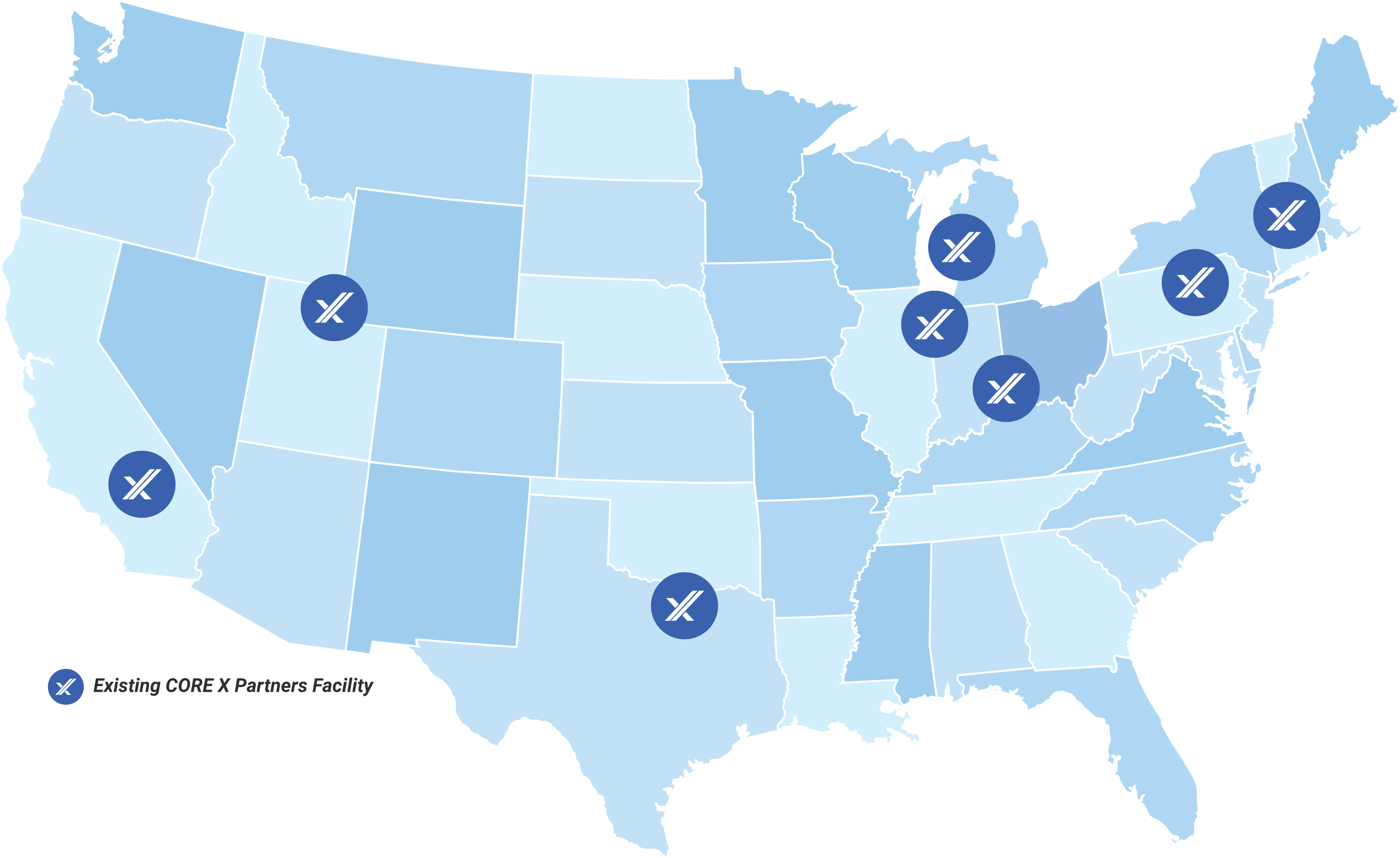
Facility geography influences freight density, service levels, and delivery predictability. A well-positioned cold storage network supports a defined two- to three-day delivery reach into major population and retail distribution corridors.
Strategic placement reduces:
- Long-haul fragmented LTL dependence
- Dwell time in congested lanes
- Cross-dock transfers across multiple terminals
It also creates density, improving trailer utilization and stabilizing transportation costs per pallet.
Shared Operating Standards Across Facilities
As distribution expands, consistency becomes more important than proximity. Scalable cold storage services maintain standardized temperature setpoints, handling procedures, documentation practices, and staging workflows across all network facilities.
This alignment ensures that products moving coast to coast experience consistent storage conditions and execution protocols. Standardization protects compliance and simplifies audit readiness across regions.
Storage and Freight Alignment
Cold storage without freight coordination introduces hidden risk. Facilities must be engineered to support consolidation programs, coordinated outbound scheduling, and controlled interfacility transfers.
When staging capacity, dock scheduling, and lane planning operate together, temperature-sensitive products move more predictably across the network. Storage and transportation become extensions of one another rather than isolated functions.
COREX Partners offers a nationwide network of strategically placed cold storage facilities, operating with regional expertise under uniform practices and procedures.
Local Service. Nationwide Network.
For a detailed breakdown of facility placement, operating logic, and freight alignment strategies, read Scalable Cold Storage Services in the US.
2. Designing the Network: Cold Chain Logistics Architecture
Cold storage capacity establishes the foundation. Network design determines whether that foundation can support national expansion.
As mid-sized food brands extend frozen and refrigerated distribution beyond a single region, logistics complexity increases quickly. New retail programs introduce varied service-level expectations. Transportation lanes multiply. Inventory must move between facilities. Seasonal volatility amplifies demand swings.
Without a deliberate cold chain logistics architecture, growth leads to fragmentation.
Mapping Demand Before Adding Distribution Centers
Scalable network design begins with demand mapping, not warehouse expansion.
Brands must understand where products are actually consumed and delivered:
- Retail distribution center clustering
- Food service density by metro area
- Order frequency and SKU velocity
- Seasonal overlays and promotional peaks
- Transportation lead times and lane exposure
Mapping demand reveals where inventory positioning supports efficient 2–3 day reach without overextending freight lanes. It also prevents unnecessary duplication in low-density regions. Adding facilities without density logic increases overhead without stabilizing service.
Hub-and-Spoke vs. Multi-Facility Regional Networks
Two primary distribution architectures dominate scalable cold chain design:
A hub-and-spoke model centralizes inventory in one or two anchor facilities. This approach works during early-stage growth when shipment frequency is moderate, and freight lanes remain manageable. It simplifies inventory control and reduces facility overhead.
However, as volumes expand, the reliance on long-haul refrigerated LTL increases, leading to more handling events. Appointment compliance risk rises. Freight cost volatility begins to affect margin predictability.
A multi-facility regional model distributes inventory across strategically placed facilities. While this introduces coordination complexity, it shortens transit distance, improves lane density, and reduces handling frequency.
Frozen products with longer shelf stability may tolerate broader hub coverage during earlier phases. Refrigerated SKUs with tighter freshness windows often require more localized positioning to maintain compliance and service performance. Scalability depends on transitioning between models at the right inflection point rather than rigidly adhering to a single structure.
Service-Level Reach and Node Placement
Effective cold chain logistics architecture targets defined delivery reach zones. Most national retail programs operate within a 2- to 3-day window. Network expansion must support that cadence without multiplying cross-dock events or intermediate transfers.
Facility placement should consider:
- Transportation corridor accessibility
- Population concentration within defined delivery radii
- Freight carrier density and seasonal capacity trends
- Risk exposure from extended staging or congested lanes
Strategic placement reduces reliance on expedited freight and improves On-Time, In-Full (OTIF) performance across regions.
Phased Expansion Rather Than Reactive Growth
Scalable networks evolve in stages.
- Phase 1 typically establishes one or two anchor hubs serving high-density corridors.
- Phase 2 extends into additional regions once shipment density and service complexity justify node expansion.
- Phase 3 introduces redundancy and optimization, strengthening resilience during peak seasons and disruption events.
Expanding prematurely increases fixed costs. Expanding too late increases transportation inefficiency and compliance risk. Deliberate network design aligns storage placement, freight lanes, and inventory positions under a single operating logic.
COREX Partners provides expanding brands with a framework for North American cold chain distribution, including storage, freight, and logistics solutions.
For a detailed framework on regional facility triggers, phased rollout planning, and logistics placement strategy, read How Mid-Sized Food Brands Should Design Their North America Cold Chain Logistics Solutions.
3. Engineering the Freight Mix: Frozen LTL, FTL, and Consolidation Strategy
Once storage architecture and facility location are established, freight execution determines whether the network operates efficiently or accumulates cost variability.
Cold freight shipping becomes more complex as frozen and refrigerated volumes increase across regions. Shipment density changes. Retail delivery windows tighten. Seasonal surges strain carrier availability. Without engineered freight alignment, transportation becomes the primary source of margin instability.
Scalable distribution requires a deliberate mix of Less-Than-Truckload (LTL), Full Truckload (FTL), and structured consolidation programs that support predictable flow.
When LTL Supports Growth
Frozen and refrigerated LTL plays an essential role during early regional expansion. It allows brands to serve emerging markets without overcommitting to full truckload capacity.
LTL works effectively when:
- Shipment frequency is moderate
- Delivery lanes remain regionally concentrated
- Handling events are minimized
- Appointment windows are consistent
In these conditions, LTL provides flexibility and controlled expansion into new territories. Reliance on unmanaged LTL networks, however, can introduce structural inefficiencies as volume scales.
When Consolidation Becomes a Margin Lever
As density increases in certain regions, repeated partial shipments tend to flow to the same markets. At this stage, consolidation strategies improve efficiency.
Structured consolidation may include:
- Pooling compatible freight into shared refrigerated loads
- Multi-stop truckload routes serving clustered retailers
- Cross-dock staging within temperature-controlled environments
- Zone-skipping strategies that bypass intermediate LTL terminals
Consolidation reduces handling frequency, stabilizes dwell time, and increases trailer utilization. The benefit is not only lower per-pallet freight cost, but improved temperature continuity throughout transit.
Engineered freight movement protects both margin and product integrity.
Lane Planning and Carrier Alignment
Scalable freight networks rely on defined primary lanes supported by consistent carrier relationships. Secondary carrier alignment and surge capacity planning protect performance during seasonal peaks or unexpected disruptions.
Lane design should account for:
- Density within origin and destination corridors
- Retail appointment compliance expectations
- Seasonal capacity volatility
- Packaging configuration and pallet stability
Freight alignment must operate in coordination with storage staging and dock scheduling. When warehouses and carriers function independently, small delays compound into larger performance disruptions.
When freight, staging, and facility placement align under shared planning logic, the distribution network operates predictably even as geography expands.
For a detailed breakdown of freight mix decisions, consolidation strategies, and hidden cost drivers in refrigerated transportation, read Cold Freight Shipping That Scales: Choosing the Right Mix of Frozen LTL, FTL, and Consolidation Across North America.
[maxbutton id=”2″]
4. Selecting the Right Cold Storage Warehousing Model
As distribution volumes increase and regional density stabilizes, storage structure becomes a financial decision as much as an operational one.
Public cold storage, semi-dedicated environments, dedicated facilities, and hybrid models each serve different growth stages. The challenge for mid-sized food brands is choosing a structure that supports expansion without incurring unnecessary fixed costs.

Public Cold Storage: Flexibility During Early Expansion
Public cold storage provides shared pallet capacity within a temperature-controlled facility. It offers variable cost alignment and minimal long-term commitment.
This model works well when:
- Volume is still stabilizing
- New regional markets are being tested
- Seasonality drives significant fluctuation
- SKU complexity remains moderate
Public storage provides geographic reach without locking the business into rigid commitments. However, as order frequency and case-pick demands increase, shared environments may limit workflow customization.
Semi-Dedicated and Dedicated Models: Control as Density Stabilizes
When a brand’s volume in a region becomes predictable, semi-dedicated or dedicated storage may improve performance stability. Defined space allocation allows tighter slotting optimization, labor alignment, and service-level consistency.
Dedicated models are typically appropriate when:
- Retail programs demand strict On-Time, In-Full (OTIF) performance
- Case picking and value-added services increase in complexity
- Throughput justifies the defined capacity commitment
- Long-term regional presence is established
These models increase operational control. They also increase structural commitment. The timing of transition matters more than the structure itself.
Hybrid Structures: Balancing Flexibility and Control
Many scalable North American cold chains ultimately operate under hybrid models. Core anchor regions may warrant semi-dedicated or dedicated storage, while emerging markets continue to rely on public capacity.
Hybrid approaches:
- Preserve flexibility in new territories
- Concentrate operational efficiency in high-volume corridors
- Reduce fixed-cost exposure during market shifts
- Align storage investment with actual density
Scaling successfully requires flexibility in storage architecture. Locking into rigid models too early can slow adaptability when freight patterns or retail coverage shift.
For a comparative breakdown of cold storage warehousing models, value-added service requirements, contract structuring, and slotting optimization, read Dedicated Cold Storage Warehousing vs. Public Cold Storage: How Mid-Sized Food Brands Can Scale Without Overcommitting.

5. Technology and Governance: The Control Layer of a Scalable Cold Chain
Cold storage placement, freight engineering, and warehousing model selection build the physical structure of a distribution network. Technology and governance create operational control across that structure.
As frozen and refrigerated distribution expands across North America, visibility gaps increase. More facilities generate more inventory data. More freight lanes introduce more tracking events. Without system alignment, growth overwhelms manual oversight.
Scalable cold chain supply chain management requires integrated visibility and disciplined governance across storage and transportation.
End-to-End Visibility Across Storage and Freight
Effective visibility begins with synchronized data between warehouses and transportation providers. Temperature monitoring, lot-level tracking, and shipment status must align across facilities.
Core visibility capabilities include:
- Continuous temperature monitoring in storage and transit
- Lot control with First Expired, First Out (FEFO) rotation
- Real-time inventory accuracy reporting
- In-transit tracking and dwell-time monitoring
- Structured exception alerts
Visibility supports compliance and performance. It allows leadership to identify drift before it escalates into spoilage, rejections, or chargebacks.
Disconnected systems create blind spots at handoff points, especially during cross-dock transfers and interfacility movements.
System Integration: Warehouse, Transportation, and ERP Alignment
Integrated Warehouse Management Systems (WMS), Transportation Management Systems (TMS), and Enterprise Resource Planning (ERP) platforms create the backbone of scalable cold chain supply chain management.
Critical handoffs include:
- Order release to warehouse pick planning
- Warehouse staging to freight booking
- Freight execution to proof of delivery documentation
- Inventory reconciliation between facilities
The objective is synchronization, not complexity. Growth amplifies inefficiency when systems operate independently.
Governance Discipline and KPI Oversight
Technology provides insight. Governance transforms insight into action.
Scalable networks maintain clear ownership for:
- Temperature deviations
- Excessive dwell time
- Appointment non-compliance
- Inventory inaccuracies
- Claims and spoilage patterns
Regular cross-functional reviews strengthen accountability. When storage, logistics, and supply chain teams review key performance indicators together, network coordination improves.
Predictive metrics, such as dwell time, temperature excursion trends, claims rate by lane, and On-Time, In-Full performance (OTIF) identify risk earlier than freight spend alone.
For a complete breakdown of the systems, KPI structures, and governance frameworks that support national expansion, read Cold Chain Supply Chain Management: The Tech Stack Mid-Sized Brands Need for a Scalable Cold Chain.
6. Compliance and Risk Planning: Protecting Integrity Across Regions
As distribution expands across North America, compliance exposure increases alongside freight volume. Additional facilities, interfacility transfers, and cross-regional lanes introduce more control points.
Cold chain compliance depends on disciplined execution across each step:
- Defined temperature standards and documentation
- HACCP-aligned operating procedures
- Consistent employee training across facilities
- Traceability systems supporting recall readiness
- Contingency planning across regions
Contingency planning maintains compliance standards during challenging situations. This process safeguards temperature control and accurate documentation, even when external conditions fluctuate. Cold chain supply networks that scale successfully build structural redundancy to protect against margin erosion from claims, rejections, and service failures. As geographic reach expands, compliance must operate under unified standards rather than isolated site practices.
For detailed guidance on building compliant, audit-ready cold chain operations, read Scaling Without Losing Quality: Cold Chain Compliance, Food Safety, and Risk Planning Across North America.
Bringing It All Together: The Six Structural Layers of a Scalable Cold Chain
Building a scalable frozen and refrigerated distribution network across North America requires alignment across six structural layers:
- Strategically positioned cold storage architecture
- Deliberate multi-region logistics design
- Engineered freight mix and lane planning
- Flexible warehousing model selection
- Integrated technology and governance systems
- Disciplined compliance and contingency planning
When any layer operates independently, friction increases. When these layers function within a coordinated network, frozen and refrigerated distribution expands with greater predictability and control.
How CORE X Aligns the Layers Across a Nationwide Network
CORE X Partners structures scalable cold chain distribution through coordinated facility placement, aligned refrigerated freight execution, disciplined warehousing models, integrated system visibility, and standardized compliance practices.
Each facility operates under shared operating standards while remaining locally led by experienced Partnering Regional Operators (PROs). This structure preserves regional responsiveness while maintaining network-level consistency across temperature control, documentation, and freight coordination.
Storage, transportation, and governance do not operate in isolation. They function within a unified framework designed to support national growth.
Local Service. Nationwide Network.
Frequently Asked Questions About Building a Scalable Cold Chain Distribution Network
How can regional food producers access national distribution without building their own network?
Regional food producers can access national distribution by partnering with a temperature-controlled network that already operates multiple strategically placed cold storage facilities across North America. Instead of investing capital in building warehouses and freight contracts in each new region, brands can leverage existing storage locations, coordinated transportation lanes, and unified operating standards.
An integrated cold chain network connects storage, transportation, and visibility systems under one structure, allowing products to move between regions without operational fragmentation. This approach accelerates geographic expansion while preserving cash flow and reducing fixed infrastructure risk.
How can food brands use LTL consolidation to reduce cold chain transportation costs?
Less-than-Truckload (LTL) shipping allows smaller pallet volumes to move without waiting for full truckload capacity, but refrigerated LTL often increases handling, dwell time, and per-pallet expense. Consolidation programs reduce these inefficiencies by staging compatible frozen or refrigerated shipments in temperature-controlled facilities and combining them into fuller outbound loads.
When consolidation aligns with inventory positioning and lane design, trailer utilization increases, accessorial charges decline, and temperature exposure during handoffs decreases. Structured consolidation reduces transportation costs while maintaining product integrity and service consistency.
How can cold chain partners support multi-channel distribution (retail, foodservice, e-commerce)?
Multi-channel distribution requires flexibility in storage configuration, order handling, and transportation execution. Retail distribution may prioritize pallet shipments to distribution centers, while foodservice often requires case-level picking and frequent replenishment. E-commerce adds direct-to-consumer fulfillment and tighter delivery windows.
Cold chain partners that support multi-channel strategies typically offer case picking, labeling, kitting, inspection, and coordinated freight services. Integrated warehouse and transportation systems ensure that temperature standards and documentation remain consistent regardless of channel complexity.
How can brands ensure food safety compliance across multiple cold storage locations?
Food safety compliance across multiple facilities depends on standardized procedures, consistent documentation, and shared operating systems. Temperature setpoints, handling procedures, and monitoring practices must align across every location within the network.
Lot control, First Expired, First Out (FEFO) rotation, quarantine protocols, and recall traceability systems must function uniformly across regions. Centralized visibility combined with disciplined training and audit readiness ensures compliance does not degrade as the network expands.
What is the biggest mistake food brands make when scaling cold chain distribution across North America?
The most common mistake is expanding storage and freight capacity without aligning the network structure. Adding isolated warehouses or negotiating transportation contracts independently creates fragmentation, visibility gaps, and rising temperature exposure during transitions.
Scalable cold chain distribution requires coordinated planning across facility placement, freight lanes, warehousing models, technology systems, and compliance standards. Growth becomes sustainable when these elements operate within an integrated framework rather than as disconnected components.
Scaling Frozen and Refrigerated Distribution Across North America
Mid-sized food brands that scale successfully do so with deliberate architecture rather than reactive expansion. Storage placement, freight design, warehousing models, technology integration, and compliance discipline must evolve together.
A scalable cold chain distribution network preserves product integrity, stabilizes margin performance, and strengthens service reliability across regions.
CORE X Partners delivers integrated temperature-controlled storage and logistics solutions designed to support structured growth across North America.Our nationwide network aligns local operational expertise with shared standards, visibility systems, and coordinated freight planning. Contact CORE X Partners to build a scalable frozen and refrigerated distribution network across North America.