Small and mid-size food manufacturers need a cold chain that can change with the business. Early on, one facility and a straightforward storage plan may be enough. Growth adds new SKUs, seasonal inventory, retailer requirements, smaller shipments, fulfillment work, and new geographic markets. The operating model has to absorb those changes without becoming harder to manage.
Customized cold chain solutions give manufacturers a way to build around real product and customer requirements. The right mix may include temperature-controlled storage, flexible capacity, refrigerated transportation, value-added services, fulfillment, and data visibility. As demand expands, regional distribution can be added where it improves cost or service instead of creating a large footprint before the volume supports it.
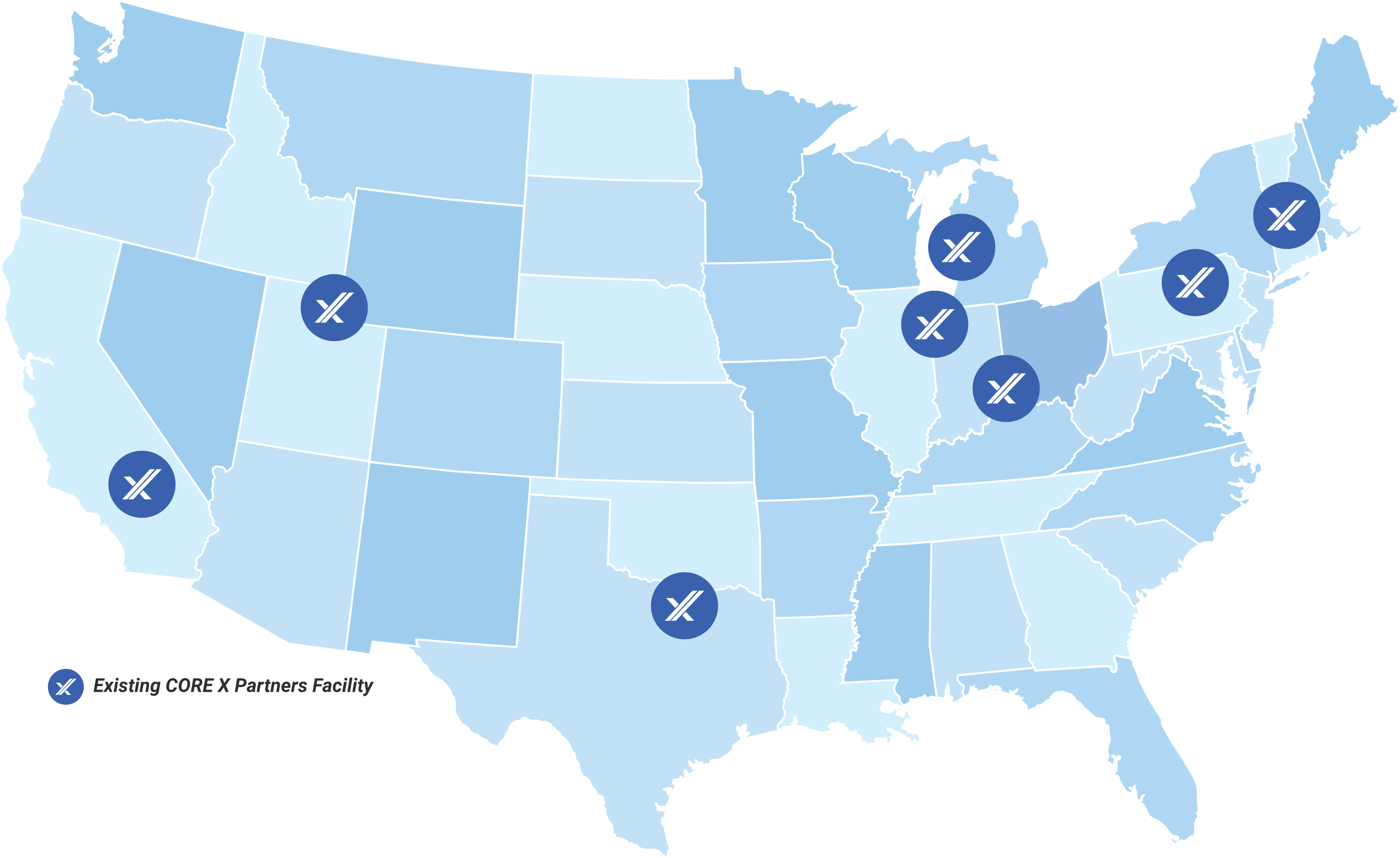
CORE X Partners supports cold storage for food manufacturers through regional operators connected by shared technology, logistics resources, and a national cold chain network. That structure gives growing brands room to add capacity and services as their requirements change.
Quick Answer: What Should a Customized Cold Chain Program Include?
A customized cold chain program should fit the manufacturer’s product profile, normal and peak volume, shipment size, handling requirements, sales channels, visibility needs, and geographic growth. It should also be practical to change. A program that works at today’s volume should have a clear path for adding capacity, freight options, warehouse services, technology, or regional distribution when the business reaches the next stage.
For most growing manufacturers, six questions shape that design:
- Can storage and handling support the current product mix and the next stage of growth?
- Can capacity expand for seasonal production without carrying peak-space overhead all year?
- Does the freight mix change appropriately between LTL, consolidation, and full truckload as lanes develop?
- Can warehouse work such as picking, repacking, kitting, and fulfillment move out of the production operation when needed?
- Will the manufacturer keep visibility into inventory, lots, temperature records, orders, shipments, and exceptions?
- Can the distribution footprint expand into additional regions without creating a collection of unrelated providers and systems?
Why Small and Mid-Size Food Manufacturers Need Flexibility
Growth usually reaches the cold chain in pieces. A new retailer changes pallet and appointment requirements. A seasonal production run creates temporary storage pressure. A new market starts with a few pallets per shipment. A direct-to-consumer program introduces picking and packing work. None of those changes alone requires a complete redesign, but together they can expose the limits of a rigid operating model.
The strongest approach is to define the current requirement clearly and leave room for the next one. That keeps manufacturers from paying for capabilities they do not need while reducing the need for emergency fixes when demand changes.
1. Build the Cold Chain Around the Product and Growth Plan
A scalable cold chain program starts with the product profile. Frozen, refrigerated, cooler, dry, and deep-frozen products create different storage and handling requirements. Shelf life, pallet configuration, lot control, expiration dating, First Expired, First Out (FEFO) rotation, and customer-specific rules also affect how inventory should move.
The manufacturer should then test the design against growth. What changes if volume doubles? What happens if a new retailer adds weekly replenishment? Can the same operating structure support more SKUs, mixed-case orders, or an additional temperature zone? These questions help identify where flexibility needs to be built in before growth creates pressure.
Freight and fulfillment belong in the same discussion. A cold chain program is easier to scale when storage, handling, transportation, and visibility are designed around the same product and customer requirements, rather than added as separate fixes.
Explore the full planning framework in How to Build a Scalable Cold Chain Program for a Growing Food Manufacturing Business
2. Plan Seasonal Capacity Separately From Baseline Demand
Seasonal production can make permanent freezer capacity expensive in one direction and restrictive in the other. Building around the annual peak may leave space underused for much of the year. Planning only for average volume can constrain production when promotions, harvest cycles, holidays, contract runs, or product launches increase finished-goods inventory.
A better capacity plan separates normal volume from the surge. Manufacturers should compare average pallet positions, peak pallet positions, production cadence, dwell time, safety stock, receiving volume, and outbound activity. The same review should identify which services need to expand with the inventory. Picking, staging, transportation, consolidation, and value-added work may all increase during the same window.
CORE X’s warehouse network supports seasonal inventory and scalable cold storage. The September blog set cites 52 million cubic feet of storage capacity and more than 220,000 pallet positions across the network. For a growing manufacturer, that scale is most useful when capacity matches the production plan and outbound flow rather than being treated as space alone.
Get the full capacity-planning approach in Seasonal Production Without Permanent Freezer Overhead: A Capacity Planning Guide for Food Manufacturers
3. Match LTL, FTL, and Consolidation to the Growth Stage
Freight strategy should change as shipment density changes. A brand entering a new market may move only a few pallets at a time. The same market may later support recurring consolidation or a dedicated Full Truckload (FTL) lane. Leaving every shipment in the same mode can create unnecessary cost, handling, or scheduling pressure.
Less-Than-Truckload (LTL) can support smaller quantities and developing markets. Consolidation can create a more planned option when compatible frozen or refrigerated shipments move toward similar regions. FTL becomes more practical as lane volume and frequency increase. The right decision also depends on temperature requirements, appointment timing, handling points, and customer expectations.
The freight rate is only one part of the comparison. Manufacturers should also look at cost per case or pallet, accessorial charges, dwell time, claims, rejected appointments, customer service workload, and On-Time, In-Full (OTIF) performance. Warehouse readiness and transportation timing should be evaluated together so product is picked and staged around a realistic outbound plan.
Compare the freight options in more depth in Frozen LTL vs. FTL vs. Consolidation: A Growth-Stage Guide for Food Manufacturers
4. Add Value-Added Services When Warehouse Work Starts Competing With Production
Growth often adds warehouse work before a manufacturer has the labor, equipment, or floor space to support it efficiently. Retailers may need specific pallet configurations. Distributors may order mixed SKUs. Promotions may require kitting or repacking. Direct-to-consumer channels create smaller order picking and packaging requirements.
Cold storage value-added services let manufacturers move appropriate post-production work into the warehouse. Depending on the program, that may include picking, case picking, repacking, kitting, pallet breakdown, re-palletizing, stretch wrapping, blast freezing, or fulfillment support. The manufacturer can keep production resources focused on making product while the 3PL handles defined warehouse tasks.
The decision should be based on the full operating cost. Internal labor, equipment, staging space, systems, supervision, and seasonal variability all matter. Service levels should also be clear before work begins, including order accuracy, turnaround time, traceability, packaging specifications, and exception procedures.
Explore where outsourced warehouse support can fit in Cold Storage Value-Added Services That Help Growing Food Manufacturers Scale Without Adding Labor and Equipment
5. Keep Visibility and Control When Execution Is Outsourced
Outsourcing storage, fulfillment, or transportation should give a manufacturer added execution capacity without creating a blind spot. Internal teams still own customer commitments, quality requirements, inventory planning, and service performance. They need timely access to the information behind those decisions.
Cold chain visibility should cover inventory quantity and status, facility location, lot and date information, holds and releases, temperature records, inbound and outbound activity, shipment status, and documented exceptions. A Warehouse Management System (WMS), Electronic Data Interchange (EDI), customer portal access, and practical reporting can connect those details without requiring a mid-size manufacturer to build a large internal technology team.
The best dashboard is the one the team can use. Inventory accuracy, order accuracy, dwell time, OTIF, freight cost per case, temperature exceptions, claims, and exception response time are useful starting points. The objective is to identify problems early enough to act and understand the cause when performance slips.
See what practical 3PL visibility should include in What Cold Chain Visibility Should a Mid-Size Food Manufacturer Expect From a 3PL?
6. Expand Beyond One Local Provider When the Distribution Footprint Requires It
A local cold storage provider can be the right answer for years. Proximity to production, direct communication, and regional knowledge are valuable when most customers can be served efficiently from one market. Expansion becomes worth evaluating when new customers, longer freight lanes, seasonal capacity limits, or additional temperature requirements begin stretching that model.
The risk is adding unrelated providers one at a time. Separate contracts, systems, reports, invoices, and escalation paths can create an administrative burden that grows faster than the distribution footprint. A connected network can preserve local operating accountability while providing shared technology, logistics access, and common operating expectations across regions.
Expansion should still be phased around demand. Manufacturers can keep primary inventory close to production, identify markets where volume has become consistent, compare freight and service performance, and add a regional distribution point when the business case is clear. Review facility placement with transportation cost, lead time, shipment frequency, and customer concentration.
Review the expansion triggers and scorecard in When Should a Growing Food Manufacturer Move Beyond a Single Local Cold Storage Provider?
How the Six Pieces Work Together
Each decision solves a different growth problem, but they work best as one operating model. Storage capacity affects production flow. Freight mode affects inventory placement and dwell time. Value-added services affect labor and fulfillment. Visibility connects the teams managing all three. Regional expansion changes the cost and service equation again.
| Growth pressure | Cold chain response | Useful measure |
| Seasonal production surge | Flexible temperature-controlled capacity tied to inbound and outbound planning | Peak pallet positions, dwell time, production cadence |
| Smaller or developing freight lanes | LTL, consolidation, and FTL mix based on shipment density | Freight cost per case, OTIF, accessorials |
| Customer-specific handling | Picking, repacking, kitting, pallet work, or fulfillment support | Order accuracy, handling cost, turnaround time |
| Outsourced execution | WMS, EDI, portal access, traceability, and exception reporting | Inventory accuracy, exception response time, claims |
| Multi-region growth | Phased regional inventory placement within a connected network | Freight miles, lead time, number of providers |
| More complex product mix | Appropriate temperature zones, lot control, FEFO, and handling rules | Temperature exceptions, aging inventory, rejected loads |
How CORE X Supports a Configurable Cold Chain Model
CORE X Partners gives growing food manufacturers access to regional operators within a broader cold chain network. That model keeps day-to-day execution close to the facility while connecting customers to shared technology, freight support, and multi-region options as the business expands.
Manufacturers can use the services that fit the current program and add others as requirements change. A company may begin with temperature-controlled storage and basic pallet movement, add seasonal capacity during production surges, introduce refrigerated LTL consolidation as retail lanes develop, or use value-added and fulfillment services when customer requirements become more detailed.
The same model can support future geographic expansion. Inventory does not need to be spread across the country before demand justifies it. Regional distribution points can be added where customer concentration, freight performance, capacity, or service requirements support the move.
Questions to Ask Before Choosing a Customized Cold Chain Partner
A provider review should test whether the operating model can handle today’s requirements and adapt as the business changes. Useful questions include:
- Which temperature zones and product profiles can the network support?
- How will normal and peak storage requirements be planned separately?
- Can receiving, picking, staging, and value-added services expand with seasonal volume?
- How do you decide when LTL, consolidation, or FTL is the better freight option?
- How are warehouse readiness and outbound transportation coordinated?
- What inventory, lot, temperature, order, shipment, and exception data will our team be able to see?
- Can service levels and reporting be standardized if we add another facility?
- How do you support customer-specific handling, shelf-life, labeling, or pallet requirements?
- What happens if production or inventory exceeds the original forecast?
- How can the network support a new retailer, region, or sales channel without rebuilding the operating model?
Frequently Asked Questions
What are customized cold chain solutions for food manufacturers?
Customized cold chain solutions are storage, transportation, handling, fulfillment, visibility, and distribution services configured around a manufacturer’s products, volume, customers, and growth plan. The mix can change as seasonal demand, shipment size, sales channels, or geographic coverage change.
Do small food manufacturers need a national cold storage network?
Not necessarily. A local facility may be the best fit while production and customers are concentrated in one region. A broader network becomes useful when longer freight lanes, new retail markets, capacity constraints, or multi-region distribution create a clear operating benefit.
How can third-party cold storage help with seasonal production?
Third-party cold storage can provide variable capacity around peak production without requiring the manufacturer to maintain the same freezer or cooler footprint year-round. The strongest seasonal plan also coordinates receiving, staging, transportation, and outbound order volume with the temporary storage requirement.
When should a manufacturer use refrigerated LTL instead of FTL?
Refrigerated LTL can fit smaller or developing shipment lanes that do not consistently support a full truckload. FTL becomes more practical as shipment volume, frequency, and lane density increase. Consolidation can provide another option for compatible recurring shipments moving toward similar regions.
What visibility should a food manufacturer expect from a 3PL?
Manufacturers should expect usable visibility into inventory quantity and status, lot and date information, holds and releases, temperature documentation, inbound and outbound status, shipments, and exceptions. Reporting should support operations, quality, customer service, planning, and performance review.
Build a Cold Chain That Can Grow with the Business
Small and mid-size food manufacturers do not need every cold chain capability on day one. They need an operating model that fits current product and customer requirements, with clear options to add capacity, freight modes, warehouse services, visibility, and regional distribution as growth creates the need.
CORE X Partners helps growing food manufacturers build that flexibility through regional cold storage operations connected by shared technology, logistics support, value-added services, and a national cold chain network. The result is a cold chain that can change with production volume, customer requirements, and market expansion while keeping local execution close to the operation.
Contact CORE X Partners to discuss customized cold chain solutions built around your products, customers, and next stage of growth.